
Retention
Reputation, flags, and trust signals
Make helpful members visible, slow down bad behavior, and give owners a moderation signal that beats vibes and crossed fingers.

Free forever. No credit card. No boring stuff.
Why it exists
Trust should have receipts.
Reputation gives every member a factory-scoped trust signal. New members start at 80, then their score and profile history move with the way they participate, get reacted to, report problems, and survive the occasional moderation review.
For members, reputation changes how they are read inside the room. Trusted and exemplary regulars can stand out. Uncertain members are easier for owners to watch. Very low reputation can pause posting and reporting so one bad actor does not turn the floor into cleanup duty.
For owners, reputation is the grown-up version of "that person seems helpful." It gives you context before you promote a member, trust a report, review a flag, or decide whether someone is contributing to the room or slowly setting it on fire.
Reputation rules
What moves the score, and what happens after a flag.

Reputation is not a popularity contest wearing a fake mustache. It is a factory-scoped trust layer tied to useful engagement, moderation outcomes, and member behavior.
- Positive signals
Helpful participation fills a reputation bucket and can raise trust over time instead of handing out instant sainthood for one good comment.
- Positive reactions: useful reactions can give the reactor reputation progress and give the author more when another member reacts.
- Good reports: when a flag is reviewed and approved, reporters earn points and reputation because cleanup work counts too.
- Sustained usefulness: accumulated reputation points can raise the score one point at a time.
- Trusted range: members at 70 or higher can show trusted status; 90 or higher becomes exemplary.
- Natural drift: after inactivity, scores above or below 80 drift back toward the starting baseline.
- Negative signals
Bad behavior can lower trust, especially when the moderation queue confirms the room was right to complain.
- Downvotes: post and comment downvotes are negative reputation events in the model.
- Thumbs-down reactions: they can reduce reputation progress for the author without taking the bucket below zero.
- Removed content: removed posts carry a stronger reputation penalty than ordinary negative feedback.
- Confirmed reports: approved flags can penalize the author and mark the flag outcome as actioned.
- False reports: malicious flagging can cost the reporter points and reputation because weaponized moderation is still bad behavior.
- Level armor
Reputation losses are softened for higher-level members because a long contribution history should matter.
- Levels 1-5 take the full reputation loss.
- Levels 6-15 take 75 percent of the loss.
- Levels 16-30 take half of the loss.
- Levels 31-50 take 25 percent of the loss.
- Levels 51+ take 10 percent of the loss, which is the Factory saying: this regular has receipts.
- Flag submission
Members can flag problems without turning every bad post into a public trial with snacks.
- Reasons include spam or advertising, harassment or bullying, inappropriate content, misinformation, off-topic content, and other.
- Flags store the reported content, author, reporter, reason, optional details, channel or topic context, and pending status.
- Logged-in Factory members can flag messages, replies, comments, forum topics, news links, and member issues where those controls exist.
- Flagging runs through the community action guard, so low reputation, frozen reputation, bans, suspensions, and daily limits can block it.
- DM reports use a separate safety path so Factory owners see the reported message without getting the entire private conversation.
- Owner review
Flags land in the moderation queue grouped by content, with reporter details and author reputation visible before the owner makes the call.
- Ignore flags: dismiss the report and prevent that content from being flagged again.
- Delete content: approve the flags, delete the content, reward reporters, and penalize the author.
- Agree with flags: hide the content, reward reporters, and penalize the author without necessarily deleting the record.
- Ban member: for member reports, owners can agree with the flags and ban the reported member.
- Disagree with flags: keep the content and penalize malicious flaggers when the report itself is the problem.
- Member impact
Reputation changes the practical experience inside the Factory, not just the decoration on a profile.
- Trusted members are easier to recognize when new people enter the room.
- Uncertain members give owners an early signal before the situation becomes a cleanup project.
- Below 30 reputation, the member is treated as soft-banned by the action guard.
- Soft-banned or frozen reputation pauses posting and reporting.
- Factory owners get a moderation signal that is better than grudges, popularity contests, and whoever typed the loudest paragraph.
Blueprints
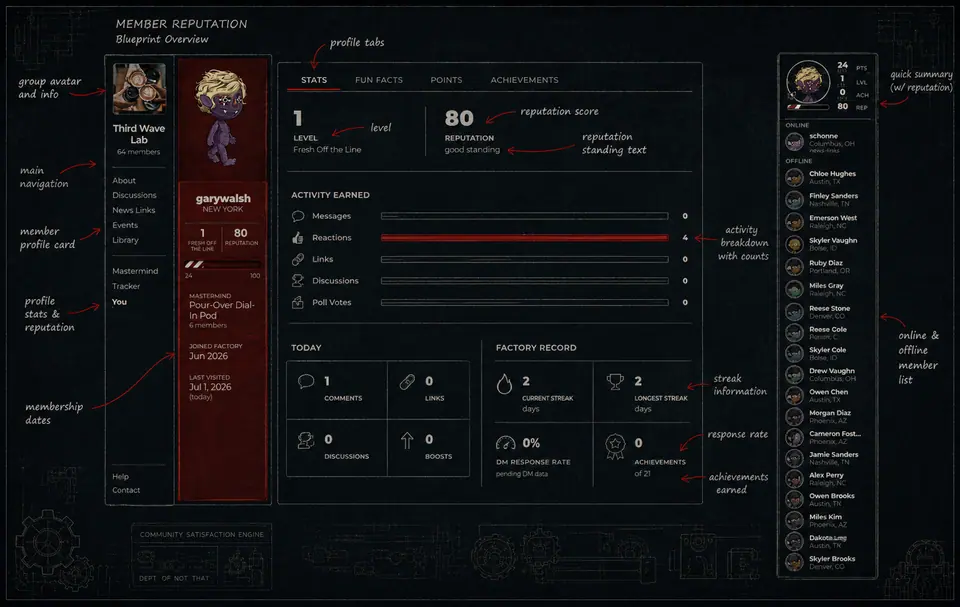
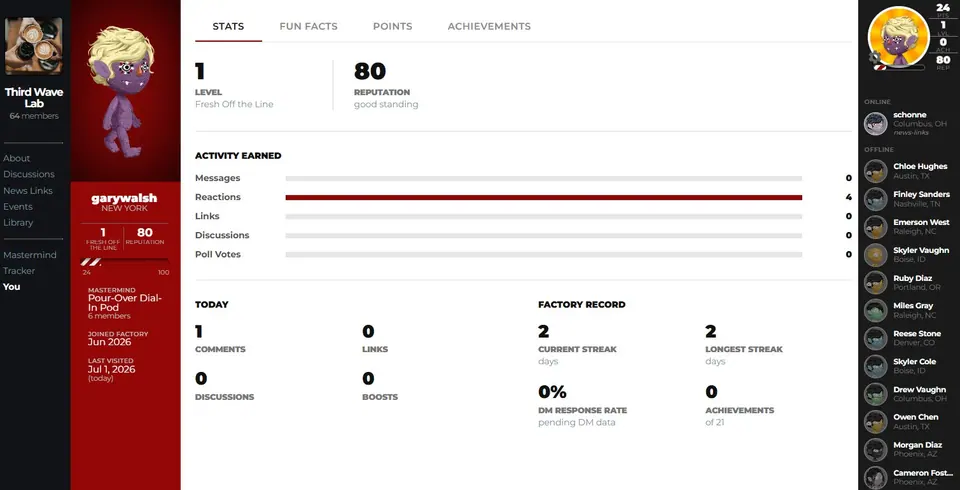
Reputation, badges, contribution history, moderation flags, and member profile context help owners see who is helping the room and who needs review.
-
Reputation Score: Every member has a factory-scoped score that starts at 80 and moves with behavior, reports, and moderation outcomes.
-
Status Badges: Trusted and exemplary members can stand out, while uncertain members give owners a useful warning signal.
-
Profile Context: Points, level, achievements, history, and reputation make regulars easier to understand before every interaction starts from zero.
-
Flag Review: Owners can review grouped flags, inspect reporter context, reward useful reports, penalize bad behavior, and close the loop.
Community fit
Why different Factory owners should care.
- Self-Help: Support rooms need trust signals for vulnerable conversations, helpful regulars, bad advice, harassment, and the person who thinks "brutal honesty" is a personality.
- Fan Club: Owners can spot superfans, organizers, helpful lore people, and recurring trouble before spoilers, scams, harassment, or fandom drama takes over the floor.
- Influencers and Celebrities: Managers can identify reliable regulars, VIP fans, ambassador candidates, and drama comets before a creator community turns into a comment section with furniture.
- Hobby or Maker: Reputation helps members know whose critique, trade offer, pattern note, repair advice, or supply recommendation has a history behind it.
- Education and Coaching: Students and clients can recognize useful peer answers, while owners can catch misinformation, bad-faith advice, and low-trust behavior before it derails the group.
- Professional Networks and Entrepreneurs: Referrals, introductions, case studies, job leads, and deal talk all work better when credibility is visible and bad actors lose trust.
- Gaming (digital or physical): Reliable organizers, rules helpers, raid leads, league regulars, and table captains become easier to spot, while harassment and rage-posting get a paper trail.
- Wellness or Fitness: Members can see trusted helpers around sensitive routines, check-ins, recovery, and coaching while dangerous claims and bullying have a moderation path.
- Local Community: Neighbors, meetup hosts, volunteers, and local organizers need familiarity and accountability before every errand, event, or favor starts from zero.
- Cause or Nonprofit: Campaign teams, volunteers, donors, and action leaders need trust signals so coordination does not depend on whoever posted most recently.
- Book or Media Club: Trusted reviewers, thoughtful debate regulars, event hosts, and spoiler-safe members can stand out while trolls and pile-ons get handled before the chapter notes become a crime scene.
Factory Floor
Build the community people come back to.
Create a Factory now, or keep touring the machinery before you decide which lever to pull first.
Free forever. No credit card. No boring stuff.