
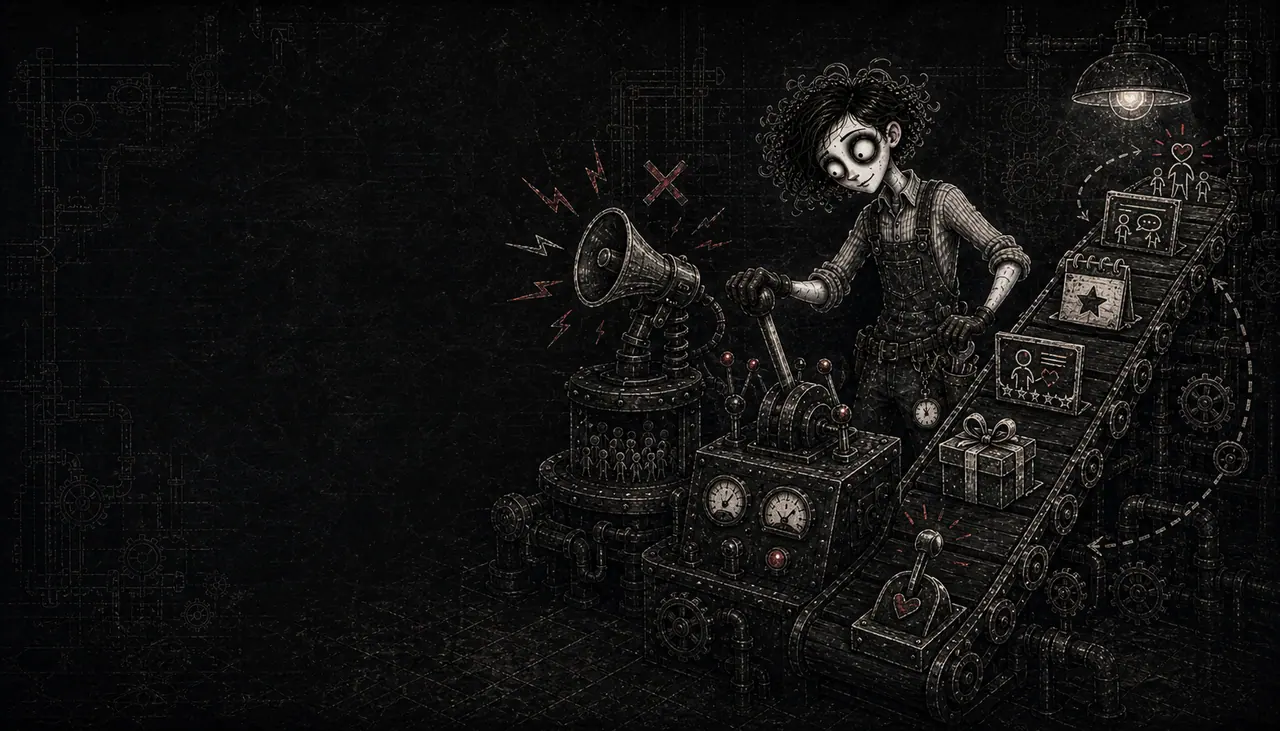
Promotion Is A Rhythm, Not A Siren
Most owners do one of two awkward things. They avoid selling because they do not want to annoy the room, then wonder why the offer is invisible. Or they panic, grab the nearest megaphone, and turn every post, comment, event, email, and welcome message into a tiny checkout counter. Neither version builds trust. One hides the path. The other makes the path feel booby-trapped.
Healthy promotion is a rhythm members can understand: useful value, believable proof, clear invitation, respectful follow-up. The rhythm repeats often enough that people know what is available, but not so loudly that the community feels like a coupon drawer with login credentials. The owner is not begging for attention. The owner is operating a signal system.
Start With One Clear Next Step
Before writing a campaign, pick the one action you want. Join the free factory. Register for the live workshop. Upgrade to paid. Book a fit call. Reply with a goal. Bring a friend to orientation. Buy the starter kit. One promotion can have one primary job. If it asks people to join, upgrade, share, comment, attend, and also admire your 11-part manifesto, the offer has become a small administrative weather event.
Write the next step in plain language, then reverse-engineer the promotion around the decision someone must make. What do they need to believe? What risk are they worried about? What proof would make the next step feel reasonable? What question needs answering before they can act? Promotion gets calmer when it is built around one decision instead of a heroic pile of selling points.
Use The Value, Proof, Invite Loop
The simplest cadence is value, proof, invite. Value helps someone before they pay: answer a real question, show a useful process, publish a checklist, run a mini teardown, or name a mistake they keep making. Proof shows that the factory creates motion: member wins, before-and-after examples, discussion excerpts, event recaps, progress screenshots, or specific stories. The invite says what to do next, who it is for, and why now is a sensible time.
This loop works because it lets promotion feel like a continuation of help, not a trapdoor under the help. A guitar factory might teach a practice fix on Monday, show three member clips on Wednesday, and invite people to Friday critique seats on Thursday. A creator business factory might explain a launch mistake, share a member who fixed it, then invite owners into a 14-day launch sprint. Nothing needs to shout when the sequence makes sense.
Turn Proof Into The Sales Team
Proof is what keeps promotion from sounding like the owner has been alone in a room complimenting the product. People want evidence that the promise survives contact with real members. Save wins, useful questions, examples of progress, event recaps, testimonials, before-and-after posts, lesson completions, and member-created artifacts. Proof does not have to be dramatic. Specific beats shiny. "Maya posted her first riff and got three fixes she used that night" is better than "people love it here."
Build proof capture into the factory instead of trying to remember it during launch week. Ask for permission when someone shares a win. Tag strong examples. Keep a proof folder. Turn weekly wins into public summaries. Use anonymous excerpts when privacy matters. Good proof lets the next invitation carry receipts instead of glitter.
Create Real Reasons To Act Now
Always-open communities still need moments. If people can join anytime, many will join someday, which is a famously slippery date. Add real reasons to act now: founding seats, live onboarding, seasonal challenges, cohort starts, workshop dates, bonus implementation reviews, price changes, limited critique capacity, or a monthly theme that begins on a specific Monday. The reason should improve the experience, not merely decorate the countdown timer.
False urgency burns trust quickly. "Only 12 spots" means something if the owner can only review 12 roadmaps. It means less if the room has infinite seats and the only limit is how dramatic the button looks. Tie urgency to capacity, timing, support load, live interaction, pricing policy, or member stage. When the constraint is real, the invitation feels like useful scheduling instead of pressure in a costume.
Make The Ask Feel Like Help
A good invitation answers a problem the prospect already recognizes. Start with the situation, not the pitch. "If your paid community has lessons but no first-week action, start here" is cleaner than "Join my amazing platform today." Use diagnostic language: who this is for, what problem it fixes, what happens inside, what the first win looks like, and who should skip it. The skip line is not weakness. It makes the yes feel safer.
A useful promotion can follow this simple map: problem, cost of waiting, quick proof, next step. Name the problem plainly. Show what gets worse if nothing changes. Show one piece of evidence. Then invite. That is enough. Owners often keep adding adjectives because they are nervous. Adjectives are cheaper than clarity, which is exactly why they multiply when no one is supervising.
Give Each Surface A Job
Promotion gets ugly when every surface tries to sell everything. Give each surface a job. The public page should explain the promise and next step. The pinned post should orient members and show the current invitation. Email can carry story, proof, and reminders. Social posts can create discovery and send people to a clearer home base. Events can create trust and action. Community threads should mostly remain useful rooms, not roaming sales booths.
Inside FanaticFactory, this means using the tools deliberately. A Start Here lesson can set expectations. A forum topic can collect wins. A live event can make the offer tangible. A library sample can prove teaching quality. A marketplace or paid tier can be the clear next step. The promotion works better when every piece points to the same door instead of repainting the whole factory every time you need revenue.
Let Members Promote With You
Member-led promotion is not "please spam your friends." It is giving satisfied members a clean way to share the room with people who would genuinely fit. Ask for referrals after a win, a useful event, a completed sprint, or a clear moment of gratitude. Give members a simple line they can forward, a public recap they can share, or a specific invite: "Bring one person who is stuck on the same thing you were stuck on last month."
Keep the fit filter close. Referrals are powerful because they carry trust, but they can also flood the room with people who are friendly, curious, and completely wrong for the promise. Tell members who belongs, who should wait, and what the first step is. A good referral system protects culture while it grows the room.
Keep The Cadence Clean
A simple promotion calendar beats random bursts of panic. Try a weekly rhythm: one useful teaching post, one proof post, one light invitation. Add one bigger monthly campaign tied to a real moment: live workshop, challenge, open house, cohort start, seasonal reset, or upgrade window. Then add quieter follow-up for people who clicked, replied, attended, or started but did not finish. Different temperatures need different messages.
Also track how much selling the room is absorbing. If every week has a launch, members stop hearing invitations and start hearing noise. If every month is silent, prospects forget the offer exists. The right cadence depends on price, trust level, relationship depth, and urgency. Start smaller than your anxiety wants. Increase only when the numbers and the room both say the signal is welcome.
Follow Up Without Chasing People
Follow-up is not pestering if it is based on real behavior and gives the person a useful next step. Someone who clicked the workshop page may need the recap. Someone who attended may need the paid path. Someone who started checkout may need the objection answered. Someone who replied with a goal may need a fit note. Treat follow-up like service with a clipboard, not a hallway chase.
Use temperature lanes. Cold prospects get useful public proof and low-pressure education. Warm prospects get examples, details, and invitations tied to their problem. Hot prospects get deadlines, availability, and direct answers. Stop after a few clean nudges. The goal is not to win a staring contest with an inbox. The goal is to make the next right step easy for people who already showed intent.
Review The Weak Link
After each campaign, do not simply ask whether it "worked." Find the weak link. Did enough people see it? Did the right people click? Did they understand the promise? Did the page answer objections? Did proof feel believable? Did the next step feel too big? Did people attend but not buy? Did buyers activate afterward? Promotion is a chain. Fix the weakest link before repainting the entire machine.
The best sign is not only sales. It is cleaner conversation. People repeat the promise accurately. Questions become more specific. Members refer better-fit people. Free members understand the paid path. Paid members arrive with the right expectations. The community still feels like a place to belong, not a hallway of posters shouting "last chance" in increasingly tired fonts. That is the goal: visible offers, calm trust, and a factory floor that still feels worth entering.
Traps That Make This Weird
- Treating silence as respect when it actually makes the offer impossible to find.
- Turning every helpful post into a pitch before people can use the help.
- Running fake urgency that is not tied to capacity, timing, support, or pricing.
- Promoting three offers at once and making the buyer choose the strategy for you.
- Using vague proof like "members love it" instead of specific outcomes and examples.
- Letting referral asks invite anyone with a pulse instead of people who match the promise.
- Changing the whole offer after one quiet campaign instead of finding the weak link.
- Counting clicks and revenue while ignoring whether new buyers activate and stay.
- Making the community feel like a sales page with comments attached.
- Apologizing for every invitation, which teaches people that buying is an awkward favor.
Implementation Checklist
- Choose one primary next step for the promotion.
- Write who the offer is for, what problem it solves, and who should skip it.
- Collect three pieces of specific proof before the campaign starts.
- Plan a value, proof, invite sequence for the week.
- Create one real reason to act now tied to timing, support, capacity, or price.
- Assign each surface a job: public page, pinned post, email, social, event, and member thread.
- Write the invitation with problem, cost of waiting, proof, and next step.
- Give satisfied members a referral prompt that names the right-fit person.
- Schedule follow-up for people who clicked, replied, attended, or started but did not finish.
- Review visibility, clicks, replies, conversions, activation, retention, and member sentiment after the campaign.
Success Metrics
- Prospects can explain the promise and next step in their own words.
- Useful posts keep earning replies, saves, shares, or DMs even when they include an invitation.
- Proof posts create qualified questions instead of vague compliments.
- Campaign clicks come from people who match the ideal member profile.
- Invite posts convert without a spike in unsubscribes, complaints, or awkward replies.
- Members refer people who understand the room before joining.
- New buyers complete the first action or onboarding step quickly.
- Revenue improves without the community feeling less useful between campaigns.
Failure Metrics
- People like the content but do not know what to do next.
- The same small group clicks every promotion while new prospects ignore it.
- Members ask basic questions the promotion should have answered.
- Campaigns create sales but poor activation, mismatched expectations, or fast churn.
- The owner keeps adding bonuses because the core promise is unclear.
- Public posts get attention from curious wrong-fit people instead of likely members.
- Community threads feel interrupted by offers instead of supported by them.
- The promotion calendar depends on owner panic rather than a repeatable cadence.