
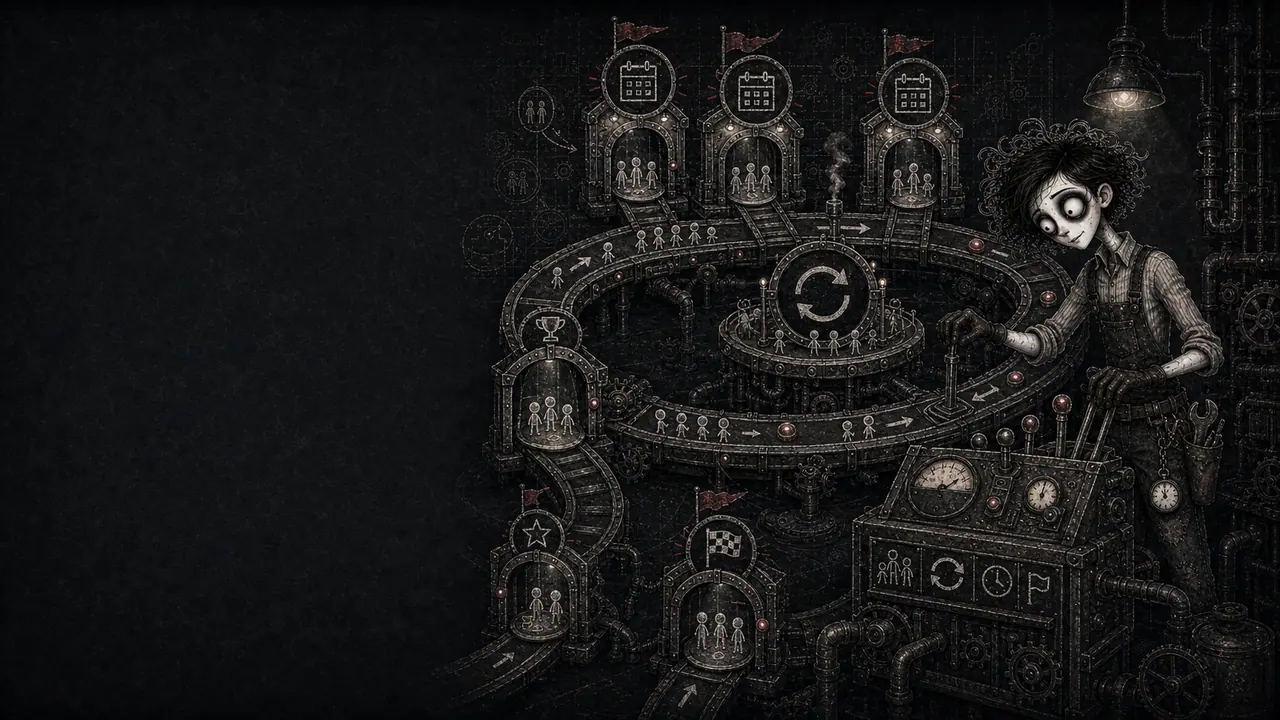
Evergreen Needs A Pulse
An evergreen community is always available. Members can join whenever they are ready, use the roadmap at their own pace, and keep returning for support, peers, updates, and identity. That is powerful. It is also suspiciously comfortable. Without moments of urgency, the evergreen promise can become a well-lit waiting room where everyone nods at the resources and quietly avoids beginning.
Cohorts give evergreen communities a pulse. They create a temporary shared start, a visible group, a deadline, and a reason to do the work now. The evergreen room stays open. The cohort creates a wave inside it. Members get the continuity of membership plus the energy of moving with other people for a defined stretch of time. That combination is the sweet spot: nobody has to wait six months for the next program, yet nobody is left alone with a library, a password, and the vague smell of abandoned ambition.
A Cohort Is A Temporary Container
A cohort is a short operating mode, not a whole business model. It gathers a defined group around a specific promise for a specific period. That might be a 14-day setup sprint, a monthly critique circle, a quarterly launch lab, a seasonal challenge, or a four-week beginner onboarding run. The point is shared motion. The cohort gives members a start line, checkpoints, social proof, and a finish line that can be seen from here without binoculars.
This distinction matters because owners often panic and rebuild the entire community around the latest exciting cohort idea. Then the evergreen base gets neglected, members outside the cohort feel abandoned, and the owner starts running a tiny school bus on fire. Keep the cohort small enough to serve the larger factory. It is a timed machine inside the factory, not the factory itself.
Use Cohorts For Starts, Sprints, And Stuck Points
Cohorts are strongest where members need momentum. Use them for new-member onboarding, beginner foundations, project launches, monthly implementation, seasonal themes, annual resets, advanced workshops, or recurring stuck points that show up in support threads. If five people keep asking how to set up the same thing, that may be a cohort. If members keep admiring a course without applying it, that may be a cohort. If everyone says "I need accountability," congratulations, the siren is making eye contact.
The cohort should name one useful result. "July Content Sprint" is better than "Summer Growth Vibes." "Finish Your First Paid Workshop" is better than "Creator Business Intensive," unless you enjoy watching members arrive carrying seventeen different interpretations. A cohort is a container for a job. Make the job specific enough that people can tell whether they belong before they click the join button.
Keep The Main Room Always On
The evergreen home base still matters during cohort weeks. It holds the library, the welcome path, ongoing discussions, support archives, member profiles, wins, recordings, and the culture that exists after a sprint ends. The cohort should point back to the main room instead of creating a secret hallway where all the useful activity disappears. Members who are not in the cohort should still understand what is happening and how they can join a future wave.
Think of the evergreen room as the factory floor and the cohort as a timed production run. During the run, activity gets louder around a specific goal. When the run ends, the artifacts, wins, examples, questions, and lessons return to the main floor. This keeps the community from splitting into "people doing the cool thing" and "people wondering why the lobby got quiet."
Design Warmup, Sprint, And Reentry
Every cohort needs three phases. Warmup gets people oriented before the official start: invite the right members, explain the outcome, collect baseline goals, ask for introductions, and give one tiny prep task. The sprint is the visible work window: prompts, deadlines, office hours, peer replies, progress posts, and reminders. Reentry brings people back into the evergreen community: publish wins, archive resources, tag useful threads, invite next steps, and show where continued support lives.
Owners often obsess over sprint content and forget the other two phases. That is how members arrive confused, then leave with a nice memory and no habit. Implementation-intention research supports concrete when-then planning, and cohorts are perfect for that. Tell members when they will act, where they will post, what response they will get, and what happens after the sprint confetti has been swept into an emotionally complicated pile.
Pick Themes By Member Stage
Theme cohorts around member stages. New members may need a Start Here cohort that gives them orientation, first posts, and an early win. Active members may need implementation sprints tied to the roadmap. Advanced members may need critique labs, expert sessions, or peer mastermind bursts. Lapsed members may need a low-pressure reactivation wave that says, with great tact, "we noticed your profile has entered museum mode." Put dates on these waves so the factory calendar feels properly alive, not randomly caffeinated.
Stage-based cohorts also protect advanced members from beginner drag and beginners from advanced-member intimidation. A single giant cohort for everyone can become a messy parade of mismatched needs. Smaller stage-based waves let people compare notes with peers who are wrestling similar problems. That makes participation easier, feedback sharper, and wins more believable.
Make Peer Presence Concrete
Cohorts work because members can feel other people moving. That feeling does not magically appear because the calendar says "cohort." Design peer presence on purpose. Use kickoff introductions, small groups, buddy check-ins, progress threads, peer feedback windows, win posts, and visible completion moments. The Community of Inquiry framework is useful here because strong online learning needs social presence, cognitive presence, and teaching presence. In plain factory terms: people, thinking, and guidance all need to show up.
Do not make every interaction depend on the owner. The owner can set the prompt, model a good response, and step in at important moments. Members should still be asked to notice each other. A cohort where everyone waits for the owner to bless each post is just a very expensive comment queue wearing a party hat.
Keep Owner Load Contained
Cohorts are tempting because they create energy fast. They also create calendar debt fast. Before launching one, count the actual operating load: kickoff, reminders, content, live sessions, critiques, moderation, DMs, recap, reentry, and follow-up. If the cohort only works when the owner heroically appears everywhere at once, the model is using adrenaline as infrastructure. Adrenaline has terrible uptime.
Use repeatable parts. One kickoff template. One weekly prompt pattern. One office-hour format. One progress thread. One end-of-cohort recap. One reentry checklist. Use automation for reminders and structure, then save human attention for judgment, encouragement, moderation, and feedback. The goal is a rhythm you can run again without needing a ceremonial nap afterward.
Turn Cohort Output Into Evergreen Assets
A cohort should leave useful debris, in the best possible way. Save the strongest questions, examples, before-and-after posts, templates, critique patterns, recordings, checklists, and member wins. Tag them. Summarize them. Put them where future members can find them. The evergreen community should get smarter after every cohort instead of starting from zero with a fresh batch of confused humans.
This is also how cohorts improve conversion. Prospects and free members can see proof that the paid or active layer creates movement. Future participants can understand what happens inside the sprint. Existing members can use old cohort artifacts as self-serve support. A cohort that produces no reusable material may still be fun, but fun without captured learning is expensive confetti.
Convert Without Ambush Tactics
Cohorts can lead naturally into paid offers, renewals, upgrades, or longer-term membership. Keep the conversion honest. The cohort should give members a real result during the sprint, then show the next level of support if they want continued accountability, deeper feedback, advanced peers, or expert access. People should feel invited forward, not trapped inside a funnel with fluorescent lighting.
Make the path obvious before the cohort begins. Free challenge to paid lab. Paid cohort to evergreen membership. Evergreen member to advanced sprint. Cohort graduate to mastermind. Whatever the path is, say it plainly. The upgrade works better when members can connect the next offer to the progress they just made.
Review, Retire, Repeat
After each cohort, review both member outcomes and owner load. Did people start? Did they post? Did they finish? Did they help each other? Did they return to the evergreen room afterward? Did the cohort create paid conversions, renewals, referrals, or reusable assets? Did the owner need three business days and a dimly lit room to recover? All of that is data. Capture the review while the cohort is still fresh, before memory politely replaces real friction with a heroic montage.
Repeat cohorts that create movement. Retire cohorts that create noise. Shorten the ones that drag. Split the ones with mismatched stages. Turn high-performing prompts into evergreen rituals. Treat every cohort as a test of timing, topic, structure, and support. Evergreen gives the community continuity. Cohorts give it seasons. Put them together well and the factory keeps running without asking members to manufacture urgency from thin air.
Traps That Make This Weird
- Running cohorts because the evergreen room feels quiet, without fixing onboarding or the weekly rhythm.
- Letting the cohort steal all energy from the main community.
- Making every cohort too broad, so beginners, active members, and advanced members all need different things.
- Launching a cohort with no warmup, then wondering why people arrive confused.
- Ending a cohort with no reentry path back into evergreen membership.
- Depending on owner attention for every useful interaction.
- Turning a cohort into a content dump with dates attached.
- Creating fake urgency around work members do not actually value.
- Forgetting to capture examples, wins, questions, and templates for future members.
- Repeating a cohort because it felt exciting while ignoring completion, retention, or conversion data.
Implementation Checklist
- Name the specific result this cohort will help members create.
- Choose the member stage the cohort serves: new, active, advanced, lapsed, or paid upgrade.
- Set the length, start date, finish line, and weekly rhythm.
- Create warmup prompts that collect goals, context, and baseline progress.
- Design the sprint with clear actions, peer presence, feedback windows, and owner touchpoints.
- Write the reentry path back into the evergreen community before launch.
- Decide which cohort artifacts will become evergreen resources.
- Define the next offer or next membership step without making the cohort feel like a trapdoor.
- Review completion, participation, support load, conversion, retention, and reusable assets after the cohort ends.
Success Metrics
- Members join the cohort with a clear goal and finish line.
- Participation increases during cohort weeks without the evergreen room going silent.
- Members post visible attempts, progress updates, questions, and wins.
- Peer replies increase during the sprint without every thread needing owner rescue.
- Cohort artifacts become searchable evergreen resources.
- Graduates continue into the main community, a paid layer, or the next relevant track.
- Owner hours stay within the planned operating budget.
- Repeat cohorts improve completion, retention, referrals, or paid conversion.
Failure Metrics
- Members sign up for the cohort and disappear before the first action.
- The cohort creates a busy week followed by an empty evergreen room.
- Members ask basic orientation questions after the sprint has already started.
- The owner becomes the only meaningful source of feedback or momentum.
- The cohort ends with no recap, reusable resources, or next step.
- Advanced members and beginners frustrate each other inside the same track.
- The cohort converts poorly because the next offer is unclear or unrelated.
- The owner avoids running the next cohort because the last one consumed too much time.