
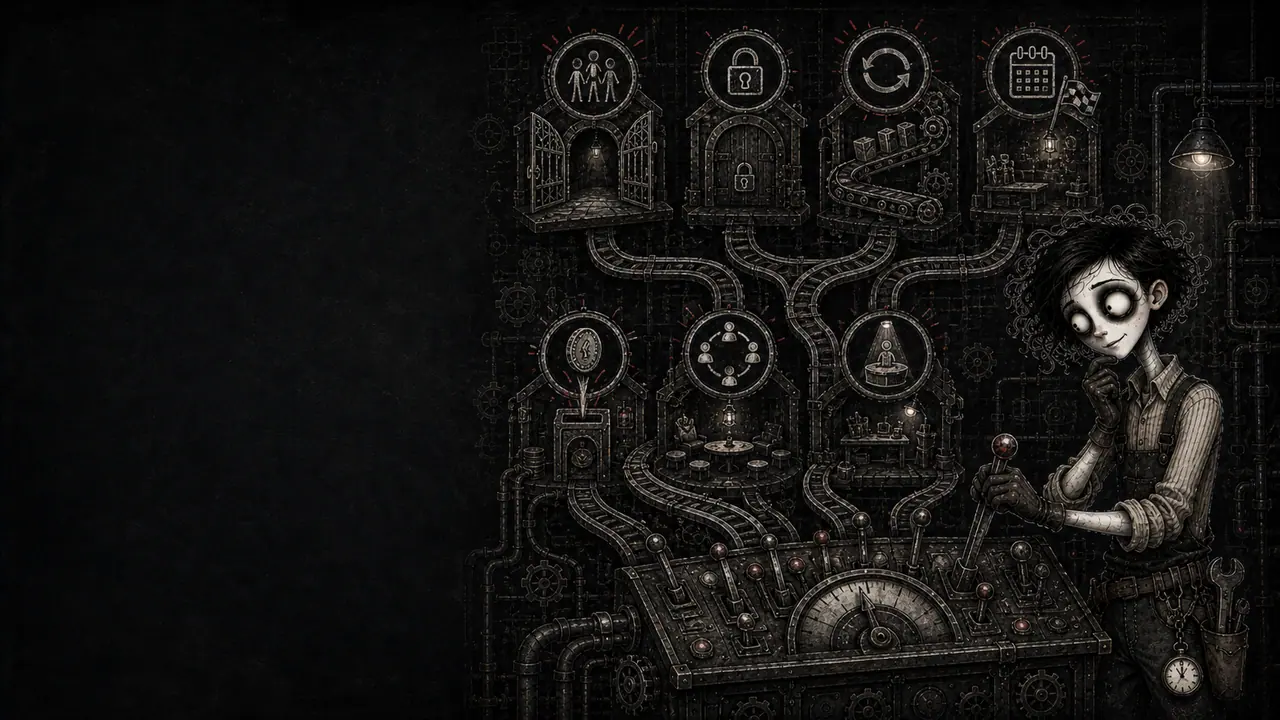
Your Model Is The Operating Manual
A community model is the operating agreement for how the room works. It decides who can enter, when people move together, how much access they get, how trust is built, how revenue shows up, and how much of the owner gets poured into the machine every week. That last part matters. The owner is usually the most expensive part of the product, even when the spreadsheet is pretending everyone is made of unlimited coffee.
Choosing the model before choosing the promise is how owners end up with a private cohort for an always-on habit, a public forum for sensitive problems, or a paid membership that mostly sells the privilege of being confused in a nicer font. Start with the result members want. Then pick the structure that gives that result enough access, urgency, safety, feedback, and continuity.
Start With The Promise And The Risk
Write the factory promise in one sentence. Then ask what makes that promise hard. Is the member blocked by lack of knowledge, lack of confidence, lack of peers, lack of accountability, lack of privacy, lack of expert feedback, or lack of repetition? The model should remove the biggest blocker first. A weekly cohort can create urgency. A private room can create safety. A public network can create reach. A paid lab can create commitment. Different wrench, different bolt.
Now name the risk. Some communities are socially risky because members show unfinished work. Some are financially risky because members make business decisions. Some are emotionally risky because the topic is personal. Some are reputationally risky because members ask basic questions in front of peers. The higher the risk, the more the model needs trust, boundaries, moderation, and controlled access. Public chaos rarely improves delicate work.
Public, Private, Or Both
Public communities are useful when discovery matters. They create proof, search visibility, shareable conversations, and a low-friction way for people to sample the culture. They work well for lightweight questions, broad topics, creator audiences, fan communities, tool support, and early market research. The tradeoff is noise. Public rooms invite casual drive-bys, thin context, moderation chores, and the occasional person who treats the reply box like a courtroom with snacks.
Private communities are useful when trust matters. They create a stronger container for sensitive questions, serious practice, paid transformation, niche identity, expert feedback, and peer accountability. The tradeoff is acquisition friction. A locked door needs a reason to exist. If people cannot see proof before joining, the sales page, testimonials, previews, and onboarding have to carry more weight. Many factories need both: a public front porch for discovery and a private workshop for serious progress.
Free, Paid, Or The Front Porch Workshop Split
Free communities are great for audience growth, research, light support, and trust building. They also teach owners a brutal little math lesson: free attention is abundant until you need consistent participation, moderation maturity, and revenue. A free room can be lively and still fail as a business. It needs a conversion path, a clear next step, and a reason the paid layer exists beyond "more tabs for your collection."
Paid communities work when the value is specific enough that members understand what their money buys: access, feedback, accountability, peers, privacy, status, speed, or proximity. Paid can improve commitment because members have skin in the game. It also raises expectations. If the paid room feels like the free room with a velvet rope and a billing form, the renewal conversation gets spicy in ways nobody enjoys.
Cohort, Evergreen, Or Seasonal Spurts
Cohorts create urgency. Everyone starts together, shares a timeline, hits deadlines, and has a built-in reason to post because the train is moving. Cohorts are strong for transformation that follows a sequence: launch a product, finish a project, learn a skill, complete a challenge, build a habit, or survive a complicated setup without quietly renaming every file "final-final-actual-final." The cost is operational intensity. Launches, calendars, reminders, events, feedback windows, and completion rituals all need hands.
Evergreen communities create continuity. Members join when ready, use the roadmap at their own stage, and stick around for ongoing practice, updates, support, identity, or access. Evergreen is strong for hobbies, professional practice, creator growth, product communities, support ecosystems, and long-term mastery. The cost is momentum. Without rituals, themes, onboarding paths, and recurring prompts, evergreen turns into a pleasant room where everyone is technically welcome and practically asleep.
Expert-Led, Peer-Led, Or Owner-Seeded
Expert-led communities work when members need judgment, taste, diagnosis, critique, or confidence from someone they trust. This is common in coaching, business, health, craft, education, and any field where the wrong move can waste time or money. The risk is bottleneck physics. If every valuable moment requires the owner, the model eventually becomes a calendar with branding and a support queue wearing shoes.
Peer-led communities work when members have enough shared context to help each other. They trade examples, encouragement, accountability, and practical fixes. Communities of practice research supports this core idea: people improve through regular interaction around a shared concern or craft. Peer-led still needs design. Seed prompts, model good replies, elevate strong contributions, and make quality visible. "The members will figure it out" is hope in a fake mustache.
High-Touch, Self-Serve, Or Guided Lanes
High-touch models include office hours, coaching, small groups, reviews, masterminds, and direct feedback. They are powerful because members feel seen and get unstuck faster. They also create capacity ceilings. Count the hours before promising heroic access. A high-touch offer with low pricing and fuzzy boundaries is how a founder becomes a haunted calendar notification.
Self-serve models scale better. They use courses, templates, searchable discussions, tagged resources, onboarding paths, and clear prompts. Self-serve works when members can make progress with structure and occasional help. Guided lanes often beat both extremes: a clear roadmap, automated orientation, peer support, periodic expert help, and upgrade paths for deeper access. The question is simple: what amount of touch does the promise honestly require?
Small Focused Rooms Beat Giant Vague Rooms
Participation inequality research is a useful slap on the desk. Most members read. Some contribute occasionally. A small minority creates most visible activity. That means a giant vague community can look empty even with lots of members, because the expected poster count is lower than the owner fantasy number written in the launch plan. Narrower rooms make participation easier because members know who the room is for and what kind of contribution counts.
Focus also protects culture. A public group for "creators" has to absorb every stage, platform, business model, and level of ambition. A private lab for "newsletter writers launching paid referral loops this quarter" knows what good looks like by Tuesday. Smaller focus can raise relevance, trust, and conversion. It may reduce raw audience size, which is fine if the business sells outcomes instead of applause.
Run The Model Stress Test
Before committing, stress-test the model against five constraints. Time: can you run this every week without becoming furniture? Trust: does the model match the privacy and vulnerability of the work? Urgency: will members act now, later, or after the sun goes cold? Revenue: does the model create a clean path to paid value? Moderation: can you protect the culture at the access level you chose?
Then test the model with one sentence: "Every week, we will..." If you cannot finish that sentence with a clear owner ritual and a clear member ritual, the model is still fog. Every model needs a weekly operating rhythm. Public needs moderation and prompts. Private needs onboarding and trust-building. Cohort needs deadlines and events. Evergreen needs recirculation and fresh reasons to return. Paid needs proof that members are getting the promised value.
Hybrids Are Fine When The Jobs Are Clear
Hybrid models are often the answer. Public front porch plus private workshop. Free community plus paid implementation lab. Evergreen home base plus quarterly cohorts. Expert-led launch plus peer-led maintenance. Open content plus closed critique. These combinations work when every layer has a job. Trouble starts when layers exist because the owner is afraid to choose and the platform menu had too many buttons.
Give each layer a promise, access rule, rhythm, owner obligation, and upgrade path. The public layer might create discovery and lightweight wins. The paid layer might create feedback and accountability. The cohort might create momentum. The evergreen room might create continuity after the cohort ends. With clear jobs, hybrid feels like a factory. Without clear jobs, hybrid feels like six rooms, three calendars, two newsletters, and one exhausted person muttering at a dashboard.
Change The Model When The Factory Changes
Your first model is a hypothesis with a nicer outfit. Review it after real members arrive. If free members engage but never upgrade, the paid layer may be unclear. If paid members churn after the first month, evergreen rhythm may be weak. If cohorts finish strong and then vanish, you may need a continuation room. If public threads keep turning messy, move serious work behind a boundary and improve moderation.
The model should evolve with evidence. Keep the promise stable while the operating structure improves. Communities get healthier when owners treat the model as machinery that needs tuning, not a sacred artifact mounted on a wall. Pick the simplest model that can deliver the promise, run it long enough to learn, then tighten the bolts where the data and member behavior point.
Traps That Make This Weird
- Choosing a model because another creator uses it, while ignoring your promise, capacity, and member risk.
- Making everything public because growth feels urgent, then discovering that trust needed a locked room.
- Making everything private before prospects have enough proof to understand why they should join.
- Running cohorts because deadlines sound sexy, while your actual offer needs long-term practice.
- Running evergreen because it sounds scalable, while your members need a shared start and pressure.
- Charging for access without defining what paid members receive beyond more content.
- Assuming peer-led means hands-off. Peer-led still needs prompts, norms, and visible examples.
- Promising high-touch access without counting the hours required to deliver it well.
- Creating a hybrid model where every layer has the same vague job.
- Changing the model every two weeks because the first few members were quiet.
Implementation Checklist
- Write the factory promise in one sentence.
- Name the primary member blocker: knowledge, confidence, peers, accountability, privacy, feedback, or repetition.
- Rate the social, emotional, financial, and reputational risk of participation.
- Choose the main access model: public, private, or public front porch plus private workshop.
- Choose the revenue model: free, paid, or free discovery plus paid implementation.
- Choose the time model: cohort, evergreen, or evergreen with seasonal cohorts.
- Choose the leadership model: expert-led, peer-led, or owner-seeded peer support.
- Write the weekly owner ritual and weekly member ritual for the model.
- Define what would make you simplify, split, or change the model after 60 days.
Success Metrics
- New members understand who the community is for and what happens after joining.
- The access level matches the privacy and risk of the conversations members need to have.
- The weekly rhythm runs without the owner constantly inventing new structure.
- Members know which layer is free, which layer is paid, and why each exists.
- Participation happens in the intended places instead of scattering across random channels.
- Paid members use the features, rituals, or access points that justify renewal.
- Cohorts finish with visible outcomes or evergreen members return through recurring rituals.
- Moderation load, support load, and owner hours fit the business model.
Failure Metrics
- Prospects like the idea but cannot explain why the community is worth joining.
- Members hesitate to post because the room feels too public for the topic.
- The private room feels invisible to prospects and hard to sell.
- The owner spends most of the week creating momentum manually.
- Free members participate but rarely move toward paid value.
- Paid members churn because the model delivers access without clear progress.
- Cohort energy collapses after launch week or evergreen activity fades between events.
- The model keeps expanding because the original structure never made a hard choice.