
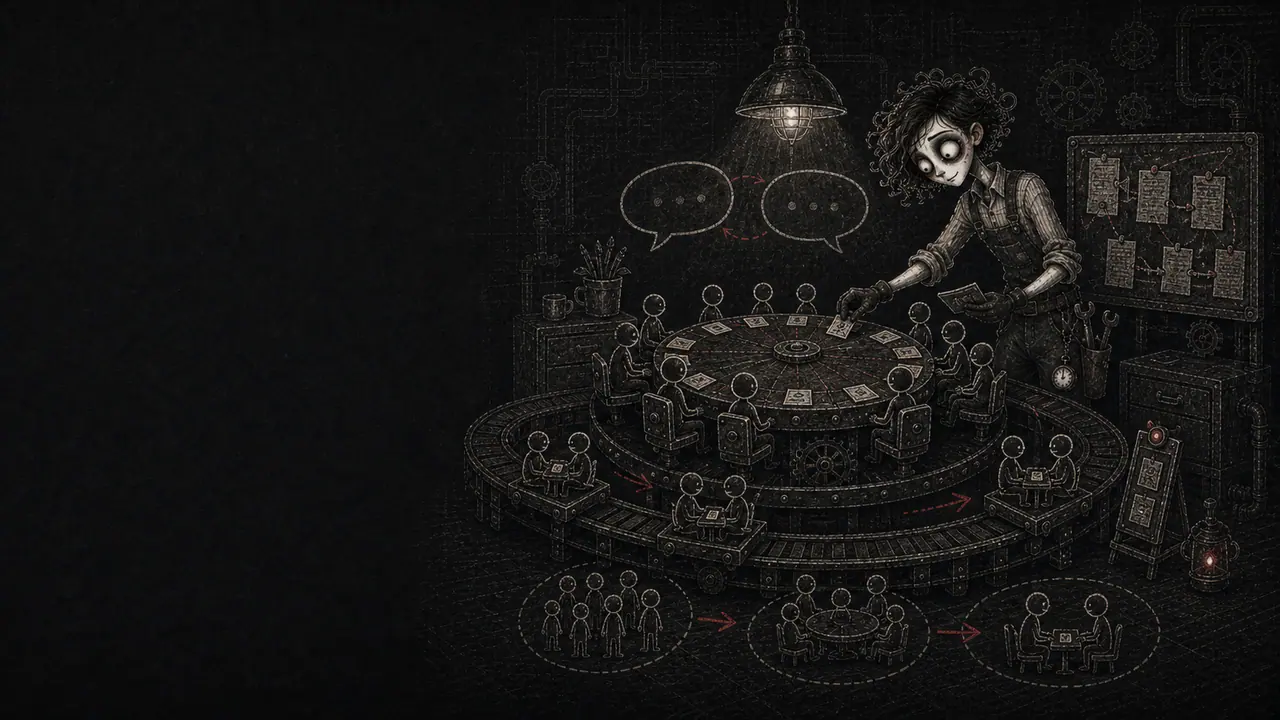
Connection Is A Designed Outcome
Most community events accidentally become content events. The owner teaches, members listen, the chat coughs up a few comments, and everyone leaves with a recording link and the emotional texture of a waiting room brochure. Useful? Sometimes. Connecting? Not much. Connection events need a different operating manual.
The goal is member-to-member movement. Members should leave knowing who else is in the room, what those people are working on, where they overlap, and what they might do next together. That does not happen because you put "networking" on the calendar. It happens because the event has structure, prompts, timing, roles, and follow-up. Otherwise the loud members talk, the quiet members inspect the mute button, and the host wonders why the factory still feels empty.
Pick The Relationship Job
Before choosing a format, name the relationship job. Are members trying to meet peers at the same stage, find accountability partners, trade examples, share wins, solve blockers, welcome newcomers, compare tools, or feel less alone in a hard season? Different job, different event. A "meet everybody" event is fog with chairs.
Good connection events are narrow enough to create relevance. "New-member intro circle for first paid workshop builders" beats "community hangout." "Local roasters troubleshooting slow weekends" beats "coffee people networking." Relevance lowers social risk because members can guess what kind of contribution belongs. Psychological safety starts before the first person speaks; it starts when the event tells people why they are in the room and what kind of risk will be respected.
Use Small Rooms Before Big Rooms
Big rooms are efficient for announcements and awkward for vulnerability. If thirty people are staring at one camera grid, most members become audience again. Connection grows faster in small units: pairs, trios, tables, breakout groups, rotating circles, and stage-based rooms. The host can still open and close the event, but the useful middle should belong to members.
Weak ties matter here. Granovetter showed that lighter relationships can move information and opportunity across groups. That is good news for communities. Not every event needs deep friendship by minute six. Sometimes the win is a member realizing, "Oh, three other people are solving the same weird problem." Design for many small, memorable contact points instead of one giant social soup.
Set Norms Before People Get Brave
Members take social risk when they speak first, ask a basic question, show unfinished work, admit confusion, or say they want help. Do not wait until the room gets awkward to explain the norms. Put the rules on the workbench before anyone picks up a tool: no unsolicited diagnosis, no pitching strangers, no recording private shares, no dunking on beginner questions, and no turning every answer into a heroic autobiography.
Norms should protect participation without making the event feel like court. Say what good participation looks like: answer briefly, make room, ask before giving advice, share examples when useful, and help the next person enter the conversation. The host can model this in the first two minutes. A clear norm stated warmly is not a buzzkill. It is the guardrail that lets quieter members drive without checking every mirror.
Prompts Need Rails
A bad prompt is either too bland or too intimate. "Tell us about yourself" is a trapdoor into job titles, life stories, and someone explaining a podcast they almost started. "Share your biggest fear" is a trust fall with a calendar invite. Use rails: specific, relevant, answerable in under a minute, and tied to the factory promise.
Try prompts like: "What are you trying to finish this month?", "What did you already try?", "What tool, habit, or example helped recently?", "Where are you stuck?", or "What kind of reply would help you right now?" Self-disclosure research supports appropriate sharing, not emotional spelunking. Start with useful context, then let depth increase if the group has earned it.
Make The Host A Traffic Controller
The host is not the star. The host is air traffic control with better lighting. They open the runway, name the purpose, model a good answer, keep time, redirect overtalking, rescue stalled groups, and close with next steps. Their job is to make member exchange feel safe, paced, and easy to enter.
Give the host a simple script: why we are here, how long each round lasts, what a good answer sounds like, how to pass, and where follow-up happens. Passing matters. Members participate more honestly when they know they can skip a question without being treated like they failed a personality exam. The event should invite risk, not demand it at clipboard point.
Design Before, During, And After
Connection starts before the call. Send a short invite that names who should attend, what will happen, what to prepare, and what kind of member will benefit. Ask one pre-event question if it helps you group people: stage, goal, topic, location, tool, challenge, or preferred table. Do not make the form feel like a customs inspection. One useful routing question usually beats eight decorative ones.
During the event, move from easy to useful. Warmup, small group exchange, table rotation, quick share-back, next-step pairing, close. After the event, capture the useful debris: attendee list, shared resources, table notes, open questions, member offers, and follow-up threads. A connection event without follow-up is a vending machine that dispenses nice moments and then rolls away.
Choose Formats By Friction
Speed networking is good when members need many light introductions. Subject tables are good when topics matter more than personality. Intro circles are good for onboarding. Problem clinics are good when people need help and examples. Show-and-tell is good when members need proof that others are doing the work. Rotating rooms are good when the community has multiple stages and you want weak ties across the factory.
Pick one friction and build the format around it. If members do not know anyone, create short pair rotations. If advanced members intimidate beginners, split by stage. If members are lonely but cautious, use low-risk prompts and optional follow-up. If the same three people dominate, use timed rounds and smaller rooms. Format is not decoration. It is the machinery that makes the desired social behavior easier.
Make Follow-Up Obvious
The best connection event creates the next interaction before people leave. Ask members to post one takeaway, tag one person they want to continue with, join a table thread, book a buddy check-in, share a resource, or answer one follow-up prompt in the factory. The next step should be small enough to do while the event energy is still warm.
This is where the factory becomes more than the event. Put table notes in the right channel. Turn common blockers into a support thread. Invite attendees to a recurring rhythm. Connect two members who asked for the same thing. The event should feed the community floor, not float above it like a very polite balloon.
Offer Async Side Doors
Live events are useful, but they should not become the only doorway into belonging. Some members have bad calendars, low social battery, time zones with opinions, shaky confidence, or jobs that make live attendance impossible. If connection only counts when someone appears on camera at the right hour, you are designing belonging for the members with the easiest Tuesdays.
Give every connection event an async side door. Let members answer the prompt before the event, add a follow-up after, join a table thread, claim a buddy match later, or post a short "missed the event, here is my blocker" note. Async participation also gives quiet members rehearsal time. They can think, answer, and return without fighting the live-call clock. That is not second-class connection. It is a ramp onto the same factory floor.
Measure Connection, Not Applause
Attendance matters, but applause can lie. A connection event can have glowing chat comments and still create zero relationships. Measure what happens after: profile views, replies between attendees, follow-up posts, buddy check-ins, event return rate, member mentions, DMs, referrals, collaborations, and whether new members post sooner after attending.
Also measure owner load. If every connection requires the host to personally introduce everyone, the event is not yet a machine. Improve the prompts, table structure, routing, and follow-up path until members can find each other with less owner matchmaking. Real connection events should make the room more alive between events. If the room only wakes up when the host turns on Zoom, the factory is still borrowing its pulse.
Traps That Make This Weird
- Treating a lecture, webinar, or office hour as a connection event because the chat was open.
- Inviting everyone to the same vague hangout and hoping relevance appears on its own.
- Using prompts that are either too generic to matter or too personal for the trust level.
- Letting the host become the star while members stay audience-shaped.
- Putting beginners and advanced members together without stage-sensitive prompts or tables.
- Skipping follow-up, so useful introductions vanish after the call ends.
- Measuring vibes and attendance while ignoring member-to-member activity afterward.
- Allowing one or two confident members to consume the entire social oxygen supply.
- Making every event synchronous when some members need async connection paths.
- Running events so often that members attend but do not deepen any relationship.
Implementation Checklist
- Name the relationship job before choosing the event format.
- Define who the event is for and who should skip this round.
- Choose a format that reduces the main social friction: strangers, stages, topics, confidence, or follow-up.
- Write three prompts that are specific, relevant, and answerable in under a minute.
- Plan the room structure: pairs, trios, subject tables, rotations, or intro circle.
- Give the host a script for purpose, timing, passing, redirects, and close.
- Collect one useful pre-event routing signal if grouping matters.
- Create a clear after-event action inside the factory.
- Capture useful questions, resources, offers, and table notes.
- Review member-to-member activity after the event before repeating the format.
Success Metrics
- Members can name at least one person they met and why that person matters.
- Attendees post, reply, DM, buddy up, or join table threads after the event.
- New members participate sooner because the first social step felt safer.
- Quiet members use structured prompts, passes, or small rooms to contribute.
- Common blockers, resources, and member offers become visible in the factory afterward.
- Repeat attendance grows without the owner personally dragging people into the room.
- Members reference each other in later discussions instead of routing everything through the host.
- The event produces follow-up activity that lasts longer than the live call.
Failure Metrics
- People attend once, say it was nice, and never interact afterward.
- The event chat is busy but member-to-member replies stay flat.
- The host answers most questions and members remain passive.
- One stage, personality, or friend group dominates the room.
- Members leave unsure who they met or what to do next.
- Follow-up threads are empty because the next step was vague or too large.
- Attendance rises while retention, activation, or referrals do not move.
- The owner has to manually broker every useful connection after each event.