
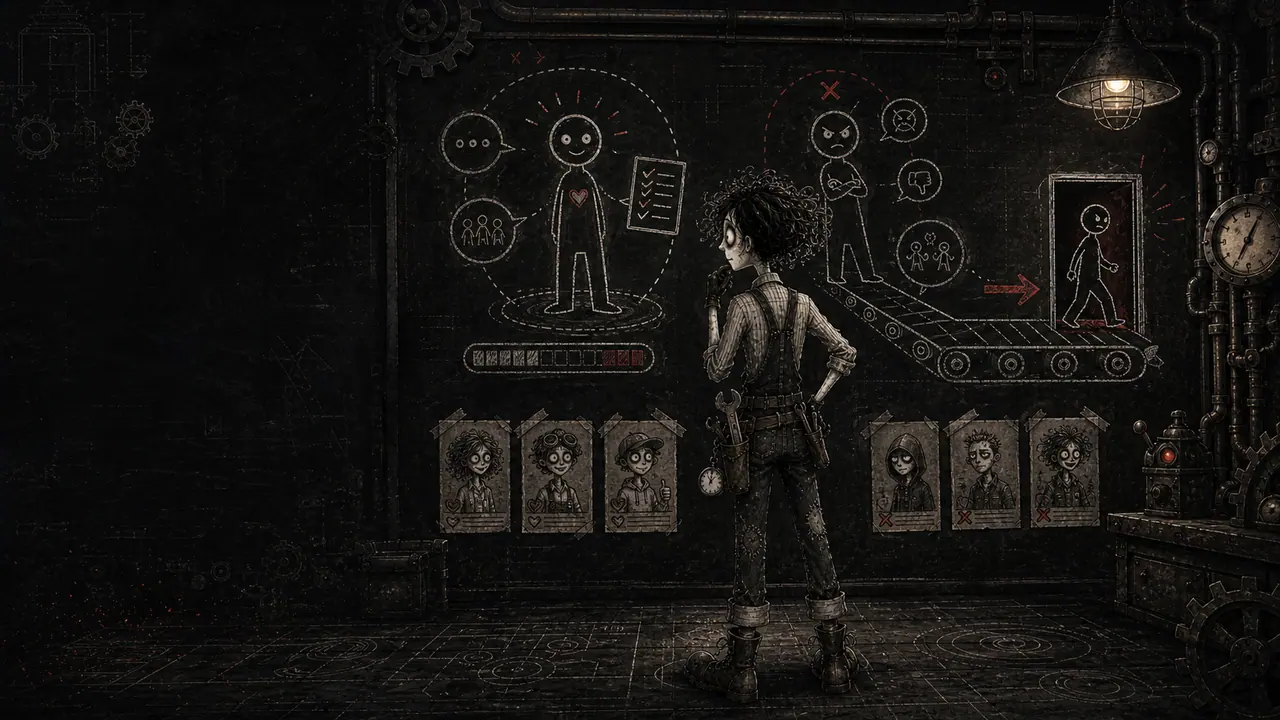
Every Factory Has A Magnet
Every community has a gravitational pull. Left alone, it attracts whoever has the loudest opinions, the fastest clicking finger, or a heroic ability to treat every room like open mic night. Your job as the factory owner is to aim the magnet before the room fills itself for you.
The ideal member is the person whose current goal, behavior, and attitude match the factory promise. The anti-member is the recurring behavior pattern that drags the room away from that promise. This exercise gives you a practical filter for invitations, onboarding, moderation, content, events, and paid offers.
Start With The Job Of The Factory
A factory exists to create a change. That change might be learning a skill, staying accountable, finding peers, shipping work, getting healthier, growing a creator business, or finally finishing the thing that has been "almost done" since 2019 and now has emotional support tabs open.
Write the promise in one plain sentence: this factory helps a specific kind of person achieve a specific outcome through a specific community experience. Keep it short enough that a tired stranger can understand it before their coffee starts judging them. A promise like "a place for guitarists" gives you fog. A promise like "a practice room for intermediate metal guitarists who want to finish tighter riffs and get useful feedback" gives you a machine you can tune.
Build The Ideal Member Profile From Behavior
Useful member profiles describe the situation someone is in and the behavior they are likely to bring into the room. Demographics can help with marketing, yet age, location, and job title rarely explain whether someone will show up, accept feedback, respect the room, or contribute without turning every thread into a tiny courtroom drama.
Ask what they are trying to accomplish right now. Ask what they have already tried. Ask what frustrates them. Ask what would make them proud in 30 days. Ask what kind of help they actually use. Ask what they contribute when they feel comfortable. Those answers tell you how to design the factory around real people instead of imaginary superfans who read every post, attend every call, buy every offer, and never need support. Those people live in spreadsheets and pitch decks. Let them stay there.
Respect Quiet Participation
A healthy ideal member profile includes more than the person who posts constantly. Participation inequality research is useful here because many valuable members read first, apply quietly, reply occasionally, and become visible after trust forms. A silent member can be learning, comparing, building confidence, or deciding whether the room is worth bringing a real question into.
Your job is to separate quiet usefulness from quiet confusion. Give members multiple healthy ways to belong: answering a poll, attending orientation, completing a Start Here lesson, posting a blocker, sharing a win, replying with a useful example, or booking help. If the only behavior you reward is constant posting, you will attract people who enjoy constant posting. Please enjoy your new weather system.
Define The Anti-Member As A Pattern
The anti-member profile should describe behavior patterns and effects. Treat it as a culture-protection tool with a clipboard and an adult relationship with evidence. Name the behaviors that reliably drain the room: self-promotion without context, contempt toward beginners, endless argument loops, support extraction, refusing basic norms, treating other members like leads, or derailing every thread into the same personal crusade.
Good boundaries are hospitality for the right members. When people know what belongs in the factory, they relax. When poor-fit behavior gets handled early, the best members become braver, warmer, and more useful. The room feels safer because the owner has decided what the room is for.
Collect Fit Signals Early
Fit signals are observable clues that someone belongs in the factory right now. They might include a concrete goal, a recent attempt, a willingness to share progress, respect for peer feedback, an appetite for structure, or a specific problem your factory is built to solve. In a fitness factory, a fit signal might be a training goal and the ability to check in twice a week. In a writing factory, it might be a draft, publishing target, or desire for critique that improves the piece.
Ask for these signals during signup, approval, onboarding, or the first Start Here prompt. Keep the intake short. A community application that feels like a mortgage form filters for people with free time and a suspicious tolerance for bureaucracy. Ask only what you will actually use, then use it immediately to route people toward the right channel, lesson, event, or offer.
Protect The Room From Wrong-Fit Damage
Wrong-fit members create cost long before they create a dramatic incident. They raise support load. They make good members hesitate. They train the room to expect argument, extraction, or vague complaining. They push the owner into reactive mode, where every week becomes a new episode of "Why Is This Happening In The Thread About Introductions?"
This is why the anti-member profile belongs upstream in onboarding, rules, welcome copy, discussion prompts, event norms, and moderation decisions. If the factory rewards helpful examples, practical progress, and respectful challenge, those behaviors become normal. If the factory lets the loudest person set the room temperature, bring a sweater and a legal pad.
Create A Path For Maybe Members
Some people fit later. They may be early, unclear, under-resourced, or better served by a different offer. Give those people a humane path. Send them to a beginner resource, a public article, a lower-touch email list, a free intro event, a prep checklist, or a later invitation. This keeps the main room focused while still being useful.
Maybe members matter because communities often grow around trust. A person who needs more prep today may become an excellent member after they finish a starter lesson, save the budget, clarify the goal, or stop trying to solve seven life categories with one login. A clean maybe path beats a messy yes.
Review Fit Monthly
Your first ideal member profile is a confident guess wearing nice shoes. After real people arrive, update it. Look at who completes onboarding, who returns, who contributes, who buys, who refers, who creates support load, and who makes other members better. The factory will tell you who it is built for if you listen before the alarm bells start doing percussion.
Once a month, read the last batch of joins, posts, DMs, event attendance, support questions, and cancellations. Tighten the profile. Rewrite one onboarding question. Add one clearer boundary. Update one welcome instruction. Fit is a living operating system, and yes, that sounds annoyingly responsible because it is.
Traps That Make This Weird
- Writing a fantasy member who loves every feature you already wanted to build.
- Confusing friendly with fit. Pleasant people can still need a different room.
- Treating quiet members as dead weight before you understand how they participate.
- Letting one hyperactive member write the culture in permanent marker.
- Using demographics alone and ignoring goals, habits, urgency, and attitude.
- Collecting intake answers and letting them rot in a spreadsheet swamp.
- Avoiding boundary language because you want the welcome page to feel endlessly open.
- Changing the whole profile after one spicy support interaction.
- Designing for complainers because they create the loudest tickets.
- Forgetting to update the profile after real member behavior gives you better evidence.
Implementation Checklist
- Write the factory promise in one plain sentence.
- Interview five current or likely members about recent attempts, blockers, and wins.
- Draft one primary ideal member profile based on behavior.
- Name three to seven fit signals you can observe during signup or onboarding.
- Draft one anti-member profile focused on behavior patterns and effects.
- Update welcome copy, Start Here content, and discussion prompts to match the ideal member.
- Add one or two intake questions that collect useful fit signals.
- Create a maybe-member path for people who need prep, a different offer, or a later invitation.
- Review retention, participation, support load, and referrals monthly for the first three months.
Success Metrics
- New members complete onboarding within seven days.
- First action rate improves: first post, first poll, first RSVP, first lesson, or first check-in.
- Members participate in the intended channels, events, or support lanes.
- Referrals start resembling the ideal member profile.
- Support questions become more specific and easier to answer.
- Moderation issues decrease or get resolved faster.
- Paid conversion improves because the offer matches the member goal.
- Retention improves among members who match the fit signals.
Failure Metrics
- New members keep asking what to do after joining.
- The most active people pull attention away from the core promise.
- The owner spends too much time calming avoidable conflict.
- Members join, browse once, and vanish.
- Content and events scatter across too many audiences.
- Intake answers sit unused.
- Good members stop posting because the room feels draining.
- Headcount grows while trust, usefulness, and paid conversion stay flat.