
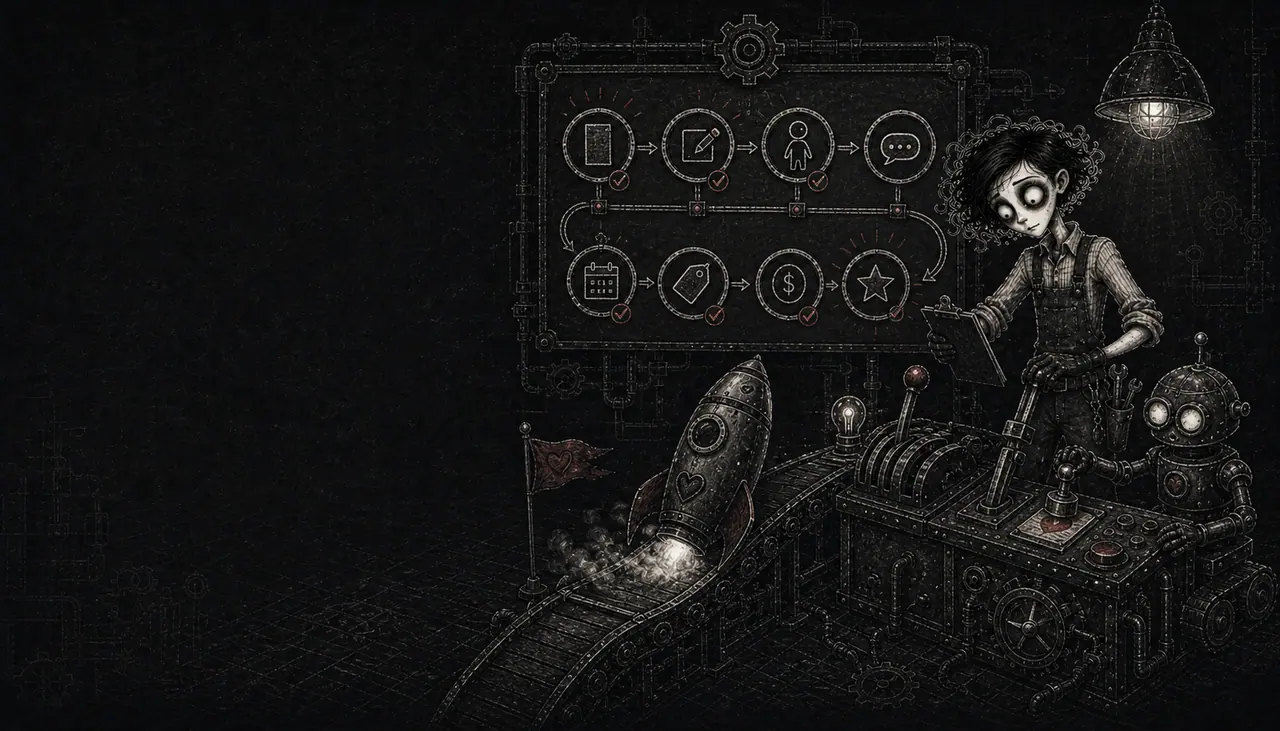
The Launch Needs A Game Board
Most owners do not fail to launch because they are lazy. They fail because the work is foggy. "Build the community" sounds noble until Tuesday arrives and the owner has to choose between rewriting the welcome copy, changing colors, creating twelve channels, checking Stripe, drafting an event, making a logo smaller, and staring at analytics that have no members yet.
A launch game board fixes the fog. It turns a vague ambition into visible squares. The owner can see what is done, what is next, what is blocked, and what counts as a win. This is not play-acting. It is operational clarity wearing a slightly more entertaining jacket.
Use Game Mechanics Like Scaffolding
Gamification does not mean sprinkling points on panic and calling it strategy. The useful version borrows game-design elements: clear goals, immediate feedback, visible progress, constraints, levels, recovery, rewards, and a next challenge. Those elements work because they reduce hesitation. The owner does not have to wonder what "productive" means today.
The research is conveniently blunt here. Reviews of gamification tend to find positive effects, but only when the design fits the context. A launch challenge should not feel like an arcade cabinet taped to a business plan. It should feel like a better checklist: more specific, more motivating, and harder to ignore.
Pick The Eight Launch Milestones
Start with eight milestones that prove the factory is moving in the real world: first page, first post, first member, first DM reply, first event, first offer, first sale, and first proof. These are simple on purpose. They move the owner from private construction to public contact, then from contact to evidence.
Do not add forty-seven bonus objectives yet. A giant mission list becomes another way to hide. The first board should answer one question: did the owner create enough of the factory for a real person to arrive, understand it, participate, respond, attend, consider buying, buy, and leave behind proof of value? If the owner cannot show evidence for one square, that square is not done.
Make Level One Almost Too Easy
The first task should be small enough to finish while motivation is still tying its boots. A launch game that begins with "write the complete manifesto, record the full course, and design the entire reward economy" deserves to be quietly unplugged. Level one should be something like: publish one clear join page with the promise, audience, price, and first action.
Small wins matter because progress changes mood. Once the owner has one completed square, the launch is no longer imaginary. It exists. The trick is to make the next move visible before the owner can wander back into polishing mode. Finish a square, stamp it, and immediately reveal the next square.
Tie Every Mission To Reality
Every launch mission should touch a person, a promise, or a transaction. "Choose accent color" is not a launch mission unless the page was unreadable. "Post the first prompt and invite three known-fit people to answer it" is a mission. "Create a spreadsheet of possible content pillars" is planning. "Send the first event invite" is motion.
This keeps the game from rewarding busywork. Owners are very good at earning fake points from private effort. The board should make that difficult. If a task does not help a member understand, join, reply, attend, buy, or produce proof, it goes in the parking lot until the launch challenge is complete.
Show Progress Where The Owner Works
A hidden launch tracker is not a tracker. Put the board where the owner will see it every day: dashboard, pinned note, whiteboard, task tool, or owner command center. Use three states only: locked, active, and complete. Anything more complicated invites the owner to manage the tracker instead of launching the factory.
Goal-setting research supports specific goals with feedback, and goal-gradient research suggests people push harder as the finish line gets closer. Use that. Show eight empty tokens at the start. Fill them as real launch evidence arrives. The owner should be able to glance at the board and feel exactly what needs doing next.
Add A Fresh Start Window
Launches benefit from a ritual starting line. Pick a seven-day, ten-day, or fourteen-day launch window and name it. Monday at 9 a.m. is better than "soon." The fresh-start effect is useful because a named beginning helps the owner stop dragging old delay into the new sprint. Yesterday was tinkering. Today is launch mode.
Keep the window short enough to create urgency and long enough to survive normal life. A seven-day challenge might cover page, post, member, reply, and event. A fourteen-day challenge can include offer, sale, and proof. Put the dates on the board, choose the review day before the sprint starts, and decide what happens if the owner misses a day. The point is not heroic pressure. The point is a container with an end.
Reward Proof, Not Polish
The best reward in an owner launch is not a decorative badge. It is proof that the factory is becoming real. Screenshot the first reply. Save the first useful question. Record the first event attendance. Capture the first sale. Collect the first testimonial, before-and-after note, or member win. Make proof the big glowing prize.
This changes the owner brain from "Is it perfect?" to "Did it create evidence?" A launch with proof can be improved. A launch with only private polish is still trapped backstage. Attach every proof item to the thing it should improve next: page copy, onboarding, event title, offer promise, or follow-up script. The challenge should make proof feel like the final key, because proof is what lets the next marketing page, offer, and onboarding path get sharper.
Use Streaks Without Shame
Streaks can help if they reward small launch behaviors: one invite sent, one reply answered, one member touchpoint, one useful public post, one proof capture. They become harmful when they turn missed days into identity drama. The owner is building a business system, not auditioning for perfect attendance.
Use streaks as prompts, not punishments. A missed day should trigger a restart card: pick the smallest active mission, do it for fifteen minutes, and mark the board honestly. Implementation-intention research supports concrete when-then plans. Use that format: "When the sprint stalls, I will send one invite before changing any design."
Give Stalls A Rescue Door
Every launch game needs a rescue door because owners stall in predictable places. The page feels embarrassing. The first post feels too empty. The first offer feels pushy. The first sale feels like a referendum on the owner as a human being. If the board has no recovery path, the owner will leave quietly through a side exit called research.
Write rescue cards before the stall happens. If the page is stuck, publish the ugly clear version. If the first post is quiet, tag five known-fit people with a real question. If the offer feels scary, sell a founder round to three people. If no sale happens, interview the no and improve the promise.
Host The First Public Moment
A factory is not launched just because the settings are finished. It needs a public moment where the owner asks people to do something. That might be a kickoff thread, live teardown, office hour, challenge day, first workshop, or tiny founder call. The event does not need to be grand. It needs to create shared attention.
This milestone matters because community energy is social. A public moment gives members a reason to show up at the same time, see the owner in motion, and notice each other. After the event, post the recap, next action, and proof. The factory should feel less like a room with furniture and more like a room where something happened.
Graduate Into An Operating Rhythm
The launch game ends when the factory has crossed from construction into operation. That does not mean everything is finished. It means the owner has enough signal to run the next cycle: improve the page, repeat the best prompt, schedule the next event, clarify the offer, follow up with buyers, and turn proof into better onboarding.
Hold a launch debrief. Which mission created momentum? Which milestone stalled? Which reward mattered? Which metric was vanity? Which real member sentence should change the page? Then retire the launch board and replace it with the operating rhythm. Do not keep replaying launch week because the owner likes the clarity. Convert the clarity into a weekly cadence of post, event, offer, follow-up, and proof. The game did its job if the owner is no longer preparing to begin. They are already in motion.
Traps That Make This Weird
- Confusing gamification with badges, confetti, and cosmetic point totals.
- Rewarding private setup work while avoiding real members.
- Creating so many missions that the board becomes another planning project.
- Letting design polish count as progress after the page is already clear enough.
- Tracking points without tying them to replies, attendance, sales, or proof.
- Making streaks feel like shame instead of restart prompts.
- Skipping the first public moment because the room feels too small.
- Calling the first sale the finish line instead of the start of proof-driven improvement.
- Forgetting rescue cards for the tasks where the owner predictably stalls.
- Measuring launch success by excitement instead of completed milestones and real evidence.
Implementation Checklist
- Choose a 7, 10, or 14-day launch window with a real start and end date.
- Create the eight milestone board: page, post, member, reply, event, offer, sale, proof.
- Define what counts as complete for each milestone using observable evidence.
- Make the first milestone small enough to complete in one focused work block.
- Remove private polish tasks from the launch board unless they unblock a real member action.
- Put the board somewhere the owner sees every workday.
- Write rescue cards for page fear, empty post fear, offer fear, and no-sale fear.
- Use a simple daily prompt: what mission moves a real person closer today?
- Capture proof as screenshots, quotes, attendance, purchases, wins, or useful objections.
- Run a launch debrief and convert the board into the next operating rhythm.
Success Metrics
- The owner completes all eight launch milestones inside the chosen window.
- At least one real member takes the first intended action.
- The first post or prompt receives a reply from a known-fit person.
- The first public moment happens, even if attendance is small.
- The first offer is made clearly to a specific audience.
- The owner captures at least one piece of proof or one useful buying objection.
- Launch work shifts from private polish to public contact.
- The debrief produces one concrete improvement to page, onboarding, offer, or event rhythm.
Failure Metrics
- The board fills with setup tasks that no member can see or use.
- The owner keeps changing design details instead of inviting people.
- Milestones are marked complete without observable evidence.
- The launch window stretches indefinitely and loses urgency.
- The first public moment is postponed until the factory feels bigger.
- No one can explain what action a new member should take first.
- The owner treats no sale as a personal verdict instead of a research signal.
- After launch week, there is no operating rhythm for posts, events, follow-up, and proof.