
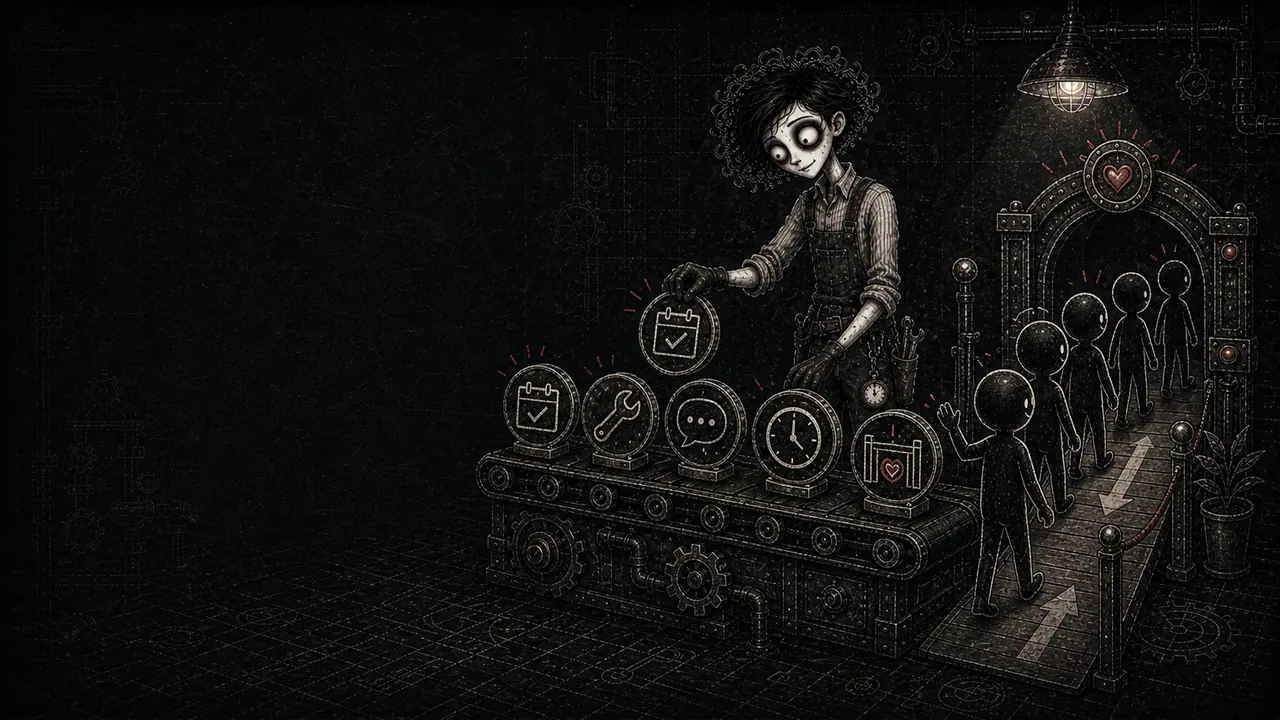
Payment Starts The Journey, It Does Not Walk It
A member purchase is a start signal, not a magic wand with a receipt attached. The owner can build the room, teach the method, create prompts, host events, answer questions, and protect the culture. The member still has to show up, try the work, give context, make decisions, and take the next small step when momentum feels less glamorous than the sales page.
This sounds obvious until support tickets begin wearing tiny disguises. "I am stuck" may mean the lesson is confusing. It may also mean the member skipped orientation, missed two calls, asked for a private roadmap, and never tried the first task. Clear responsibilities let you tell the difference without turning every issue into detective work with a calendar.
Write The Member Job Description
Every factory needs a plain-language member job description. Not a stern legal scroll. A working agreement. Members are responsible for setting a goal, using the Start Here path, asking with context, trying before escalating, respecting other members, keeping appointments, sharing progress honestly, and using the right support lane for the right problem.
Make it short enough to read during onboarding and specific enough to settle arguments later. "Participate respectfully" is fine, but "challenge ideas, not people" is better. "Ask good questions" is fine, but "include what you tried, where you got stuck, and what result you want" actually changes behavior. Vague rules are decorations. Concrete rules are handles.
Define The Owner Promise Just As Clearly
Boundaries feel fairer when the owner promise is equally visible. State what the factory provides: curriculum, prompts, community access, live sessions, office hours, feedback windows, moderation, templates, reminders, or accountability rhythm. Then state what it does not provide: unlimited private consulting, emergency support, guaranteed results, custom implementation, personal therapy, legal advice, or endless reschedules.
Customer participation research matters here because many services are co-produced. The customer, student, client, or member helps create the outcome. A personal trainer can write the workout, but the member still lifts. A founder can run a business sprint, but the member still contacts prospects. The factory result is shared work, not owner wizardry.
Set The First-Result Expectation
Members need an early win and a realistic clock. Tell them what the first result should be and when it usually happens if they follow the path. "In your first seven days, complete orientation, post your goal, and submit one attempt for feedback." That is not dramatic. That is the point. It gives the member a clean finish line before they get lost admiring the tool shelf.
Goal-setting research supports specific goals with feedback, and implementation-intention research supports concrete when-then plans. In factory language: make the next action impossible to confuse. When you join, do this. If you miss the live session, watch this replay and post here. If you get stuck, use this form with these three details.
Make Support Lanes Visible
Support trouble often starts when every question goes through the same tiny doorway. Create lanes. Public questions go in the forum so others can learn. Sensitive billing issues go to support. Coaching questions go to office hours. Bugs go to a report form. Peer feedback goes in the critique thread. Urgent safety or conduct issues go to the owner or moderator path.
Write response expectations beside each lane. Forum replies may take 24 to 48 hours. Office-hour questions are answered live. Private support handles account access, not strategy rewrites. DMs are not guaranteed support unless the tier includes them. This does not make the factory cold. It keeps help findable and keeps the owner from becoming a one-person switchboard with a haunted inbox.
Put No-Show And Reschedule Rules On Rails
No-shows and last-minute reschedules are where nice communities quietly become unpaid calendar storage. Write the rule before it gets personal. For example: members can reschedule up to 24 hours before a coaching call, one late reschedule is forgiven, no-shows count as used sessions, and repeated misses move the member to group support until attendance stabilizes.
The rule should protect real people, not punish normal life. Emergencies happen. Kids get sick. Cars invent smoke. Give yourself a human exception lane, but do not make exception the default operating system. Predictable rules help reliable members get fair access, and they stop the owner from making policy at 11:07 p.m. while annoyed and holding a mug.
Protect Owner Time Without Hiding Behind Policy
Owner time is part of the product. Spend it where it creates the most member progress: diagnosis, feedback, culture-setting, hard decisions, expert guidance, and high-leverage examples. Do not spend it retyping instructions, chasing missing homework, rebuilding skipped onboarding, or answering the same DM that already has a public answer three clicks away.
A useful boundary sounds like service, not a slammed gate: "I want this answer to help everyone, so post it in the feedback thread." "That needs a coaching review; bring it to office hours." "I can answer one focused question if you include what you tried." The boundary points the member toward the machine instead of making them feel personally rejected.
Match Boundaries To Tiers
If the factory has free, paid, premium, coaching, or mastermind tiers, each tier needs its own responsibility map. Free members may get public prompts and community replies. Paid members may get structured feedback windows. Premium members may get office hours. Coaching clients may get private review, but only inside the agreed cadence and scope.
Tier boundaries prevent resentment on both sides. Members understand why one lane is public and another is private. The owner can say yes to deeper support without accidentally giving everyone the most expensive version for the cheapest price. A tier is not only a price label. It is a support contract with a different amount of human attention.
Use Consequences As Guardrails
Consequences do not need to arrive wearing a cape and shouting. They can be simple: reminder, redirect, warning, temporary pause, lost appointment, limited posting, refund-and-exit, or removal. The important part is that consequences match the pattern, not the mood of the person enforcing them. A tired owner is not a governance framework.
Visible norms improve participation because members can predict the room. Pew harassment research is a reminder that unclear or unsafe spaces push people away, especially the members you most want to keep. Boundaries protect good members from the few who consume oxygen, create ambiguity, or treat other people as free infrastructure.
Give Members Autonomy Inside The Fence
Boundaries are not there to make members obedient. They are there to make participation easier. Give members choices inside clear rails: choose a weekly goal, choose which prompt fits, choose whether to post publicly or bring a private issue to office hours, choose a beginner or advanced lane, choose when to request feedback inside the window.
This matters because people stick with work when they feel agency, competence, and connection. A factory that only says "do this or else" will feel like a clipboard with a login. A factory that says "here are the rails, here are your choices, here is how to get help" feels like a place adults can actually use.
Practice The Awkward Scripts
If you wait until a member is upset to invent the boundary script, your brain may print something either too mushy or too spicy. Write the common scripts now: missed call, wrong support lane, low-context question, refund request, disrespectful comment, repeated non-participation, overuse of private access, and asking for custom work outside the tier.
Keep scripts short and humane. Name the issue, restate the rule, point to the next step, and leave dignity on the floor for everyone to pick up. Example: "I can help better if this comes through the feedback thread with your draft and the blocker. Please post it there, and I will review it in the Friday window." Firm. Useful. No courtroom music.
Turn Boundaries Into Onboarding
Do not hide responsibilities in a terms page that nobody reads unless they are already angry. Put them where behavior begins: checkout copy, welcome email, Start Here lesson, pinned post, coaching intake, event reminder, feedback form, and channel descriptions. Repetition is not nagging when it prevents confusion at the exact moment confusion usually appears.
Use examples. Show a good question and a weak question. Show what belongs in office hours and what belongs in support. Show how to reschedule. Show what happens after a missed call. Show how to ask for feedback. New members should leave onboarding thinking, "I know how to be helped here." That sentence is community infrastructure.
Review Boundaries From Real Incidents
Your first boundary draft will not be perfect. That is fine. Review it with real incidents instead of imaginary catastrophes. Where did members get confused? Which support questions repeated? Which rule felt harsh? Which behavior drained the owner? Which good members went quiet because one person kept bending the room around themselves?
Once a month, update one thing: a support lane label, a script, a reminder, a checklist, a consequence ladder, a reschedule rule, or a first-week action. Boundaries are not a statue. They are shop markings on a busy factory floor. Keep repainting the lines where people actually walk.
Traps That Make This Weird
- Writing boundaries only after one difficult member has made the owner furious.
- Making the member responsible for results while hiding what the owner actually provides.
- Using vague rules like "be respectful" with no examples of what respectful means here.
- Letting DMs become the secret premium support lane for everyone.
- Creating no-show rules but making exceptions so often that reliable members get less access.
- Confusing firm boundaries with cold service.
- Writing a giant policy document that never appears during onboarding or support moments.
- Punishing beginners for confusion that the factory created with bad labels or missing instructions.
- Letting one generous owner decision become a precedent the whole room can now demand.
- Tracking revenue while ignoring whether owner time and member expectations are still sustainable.
Implementation Checklist
- Write the member job description in plain language.
- Write the owner promise and the owner non-promise beside it.
- Name the first seven-day result and the exact actions required to reach it.
- Create support lanes for public questions, private account issues, coaching, bugs, feedback, and conduct.
- Set response-time expectations for each support lane.
- Write no-show, late-cancel, reschedule, and repeated-miss rules before the next live offer.
- Create a consequence ladder: reminder, redirect, warning, pause, refund, removal, or other fit action.
- Draft scripts for the five awkward conversations most likely to happen.
- Place responsibilities and boundaries inside onboarding, prompts, forms, event reminders, and pinned posts.
- Review one month of incidents and update the smallest boundary that would prevent repeat confusion.
Success Metrics
- New members can explain what they are responsible for during the first week.
- Support requests arrive in the right lane with enough context to answer well.
- First-action completion improves because the expected first result is obvious.
- No-shows, late reschedules, and repeated missed commitments decline.
- Owner private-message load drops without a drop in member satisfaction.
- Moderators and helpers can enforce boundaries consistently without guessing owner mood.
- Good members participate more because the room feels fair and predictable.
- Refunds and churn are tied to genuine fit instead of surprise, confusion, or unmet hidden expectations.
Failure Metrics
- Members keep asking what to do first after they have already joined.
- The owner repeatedly answers the same question in private because public support lanes are unclear.
- High-maintenance members receive more attention than reliable members.
- No-show rules exist on paper but not in actual behavior.
- Members complain about unfairness because exceptions feel random or invisible.
- Support conversations become arguments about what was promised.
- The owner avoids opening messages because every request could become a custom project.
- Good members stop posting because the boundaries protect the loudest people more than the useful people.