
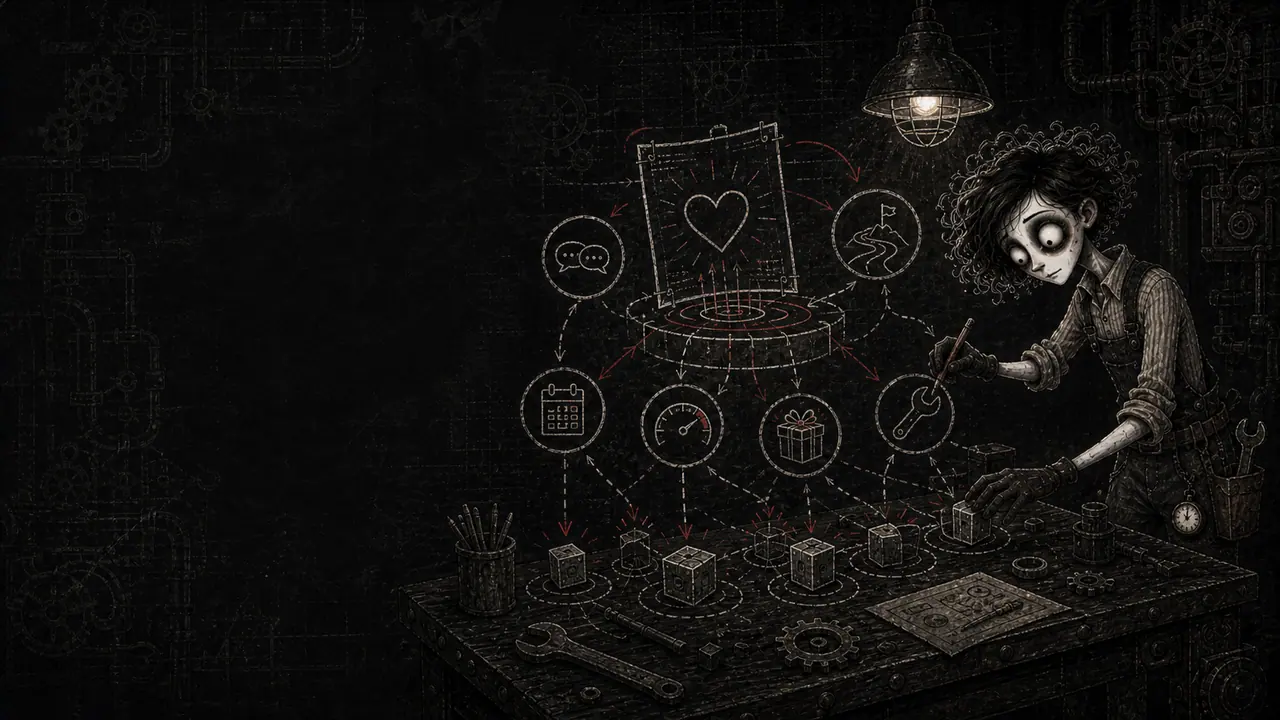
Feature Requests Are Tiny Disguises
Members rarely ask for features in the language of the promise. They ask for a channel, a replay library, a badge, a calendar, a leaderboard, a private room, a poll, a form, or one more tab because apparently tabs reproduce in captivity. Under the request is a job they are trying to get done.
Your job is not to obey the first noun. Your job is to translate the noun into progress. "We need events" might mean members need urgency. It might mean they need live feedback. It might mean they are lonely, confused, or waiting for permission to start. Same feature request, five different machines.
Start With A Promise You Can Test
Write the factory promise as a testable result: this factory helps a specific kind of member create a specific change through a specific community experience. If the promise cannot be tested, every feature feels equally reasonable. That is how a community becomes a digital garage full of tools nobody can find during the actual emergency.
A testable promise gives you a ruler. If the factory promises to help indie authors finish a cleaner first draft in 90 days, then a critique thread, sprint calendar, progress tracker, and feedback ritual all make sense. A marketplace, news feed, and meme channel might be nice later, but they do not get first chair in the orchestra.
Name The Five Kinds Of Friction
Most useful features reduce one of five frictions: risk, time, effort, sacrifice, or disbelief. Risk asks, "Is this safe enough to try?" Time asks, "Can I fit this into my actual week?" Effort asks, "Do I know what to do next?" Sacrifice asks, "What do I give up to participate?" Disbelief asks, "Will this work for someone like me?"
Now your feature decisions get less mystical. A private channel reduces social risk. A Start Here lesson reduces effort. A weekly sprint reduces time fog. A short async check-in lowers sacrifice for busy members. Member wins, progress bars, examples, and feedback increase belief. Features become tools for removing a named blocker, not decorations on the factory wall.
Translate Promise Into Member Behavior
A promise only becomes real when members do something differently. So name the behavior before naming the feature. Do they need to post a first attempt, ask for help, RSVP, upload proof, complete a lesson, reply to a peer, log a habit, buy a template, book coaching, or invite a friend? The behavior is the moving part.
The Fogg Behavior Model is useful here because action needs motivation, ability, and a prompt. If members are motivated but the step is hard, make it smaller. If the step is easy but nobody cares, tie it back to the promise. If both are true but nothing happens, your prompt is missing, late, vague, or hiding behind a button that needs a map and a flashlight.
Make The Smallest Feature That Changes Motion
The first version of a feature should be almost rude in its directness. If members need accountability, start with a weekly check-in thread before building a challenge engine. If they need peer feedback, start with one critique format before building matching logic. If they need a resource path, start with three steps before filming a ceremonial mountain of content.
Small does not mean lazy. Small means the feature has one job and you can tell if it worked. A weekly check-in either creates visible commitments or it does not. A critique prompt either produces better replies or it does not. A setup checklist either lowers repeated support questions or it sits there like a clipboard with trust issues.
Use A Promise To Feature Map
Create a simple map with five columns: promised result, member blocker, desired behavior, smallest feature, and proof signal. For every candidate feature, fill the row before you build. If the row fights back, that feature is probably a shiny bolt rolling under the workbench. Leave it there until it earns a real job.
Here is the magic trick without the smoke machine. Promised result: members finish their first paid workshop. Blocker: they do not know what to sell. Desired behavior: post a one-sentence offer for feedback. Smallest feature: Friday offer thread with an example response. Proof signal: five offers posted, three peer replies each, fewer "what should I sell?" support questions next week.
Design For Belief, Not Just Access
Many owners accidentally build access instead of belief. They open more rooms, upload more lessons, and enable more tools. Members technically have everything and emotionally have a small blinking cursor. Belief needs evidence, sequence, feedback, and examples. People need to see that the promise is possible, that the next step is safe, and that the room will respond usefully.
This is where progress indicators, member wins, tagged examples, before-and-after posts, feedback loops, and owner commentary matter. They are not vanity furniture. They answer the quiet question every member brings into the factory: "If I do this here, will anything actually change?" If the feature cannot help answer that, it may be access pretending to be value.
Let Feedback Pick The Next Build
After the smallest version ships, watch the room. Count starts, completions, replies, support questions, event attendance, lesson progress, repeat visits, paid clicks, and confused DMs. Read the language members use when they get stuck. Feedback research is blunt in a helpful way: people need to know where they are going, how they are doing, and what to do next.
That means the next build should come from behavior, not owner anxiety. If members start but do not finish, add pacing or reminders. If they finish but do not improve, add feedback. If they lurk but never start, lower risk. If they ask the same question repeatedly, improve information scent, labels, examples, or the route into help.
Retire The Feature That Lost The Plot
Promise-led design also tells you what to kill. A feature can be loved and still wrong for the factory. It can be active and still distracting. It can be impressive and still make the promised result harder to reach. This is annoying because deleting a feature feels less glamorous than launching one. Do it anyway.
Once a month, review the map. Keep features that move the promised behavior. Improve features that almost work. Merge features that split attention. Retire features that create noise, support load, or false progress. A strong factory is not the one with the most machinery. It is the one where every machine knows what it is building.
Traps That Make This Weird
- Building the feature members named before translating the progress they need.
- Writing a promise so broad that every feature can pretend it belongs.
- Confusing access with value. More rooms do not automatically create more progress.
- Building a complete system before testing the smallest useful behavior.
- Using engagement as the proof signal when the promise is really about outcomes.
- Letting owner anxiety pick the roadmap after one quiet week.
- Adding features that lower effort but increase confusion.
- Designing for the loudest request instead of the highest-friction blocker.
- Forgetting belief. Members need proof that action here leads somewhere.
- Keeping features because they were hard to build, not because they still work.
Implementation Checklist
- Write the factory promise as a specific, testable member result.
- List the top five blockers between members and that result.
- Classify each blocker as risk, time, effort, sacrifice, or disbelief.
- Name the behavior that would prove the blocker is getting smaller.
- Choose the smallest feature, ritual, prompt, or lane that could create that behavior.
- Write the proof signal before building.
- Launch the smallest version for one to four weeks.
- Review starts, completions, replies, support questions, and paid intent.
- Improve, merge, or retire the feature based on behavior.
- Repeat the map monthly before adding anything new.
Success Metrics
- Members understand the next action tied to the promise.
- First-action rate improves after the feature launches.
- Support questions become more specific and less repetitive.
- Members complete more promise-relevant behaviors, not only more clicks.
- Peer replies and owner feedback happen in the intended lanes.
- Feature usage correlates with retention, completion, upgrade intent, or referrals.
- The owner can explain why each active feature exists.
- The roadmap gets shorter because weak features are merged or retired.
Failure Metrics
- Members praise the idea but do not use the feature.
- Usage is high but the promised result does not move.
- The feature creates new support questions instead of reducing friction.
- Members use the feature in ways that pull attention away from the promise.
- The owner keeps adding rooms, events, or resources to fix unclear strategy.
- New members cannot tell where to start or why a feature matters.
- Paid conversion stays flat because features feel disconnected from outcomes.
- The factory feels busier while trust, progress, or revenue stays stuck.