
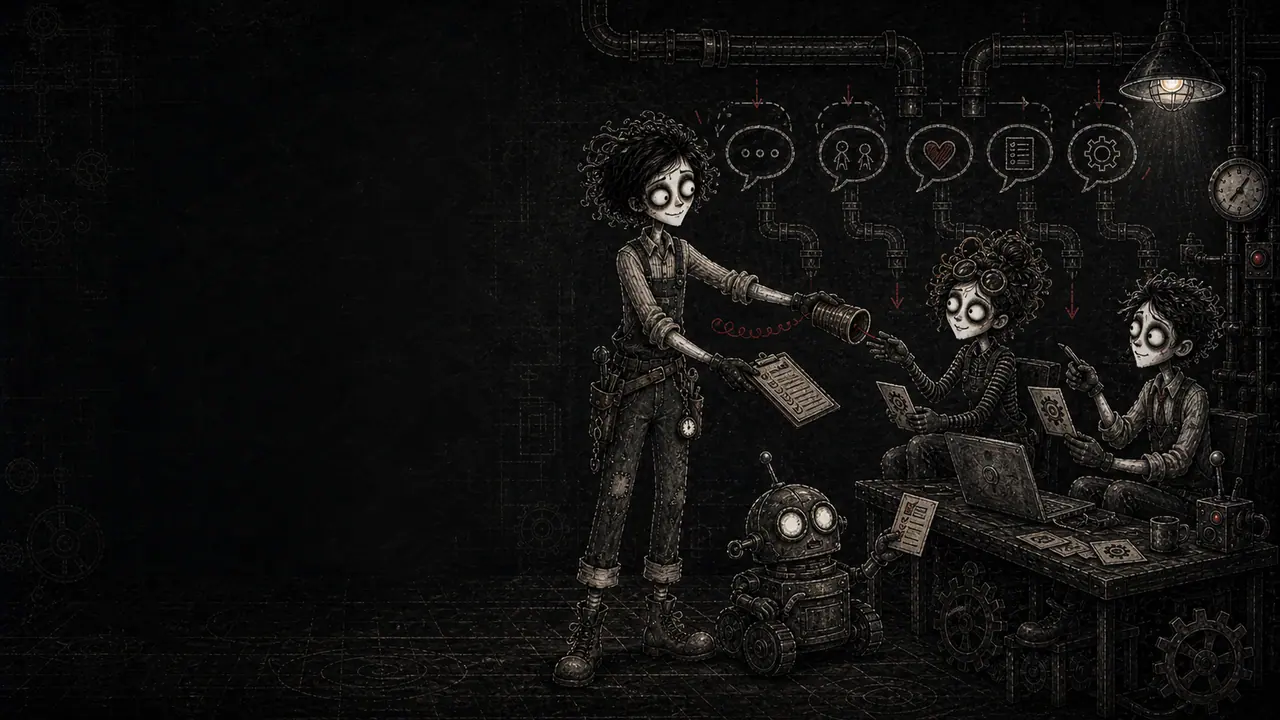
The Voice Is Not The Founder Typing Faster
At first, the founder voice is easy because the founder is doing everything. Every welcome note, support reply, event post, lesson intro, weird joke, boundary call, refund answer, and late-night pep talk comes from the same human. Members learn the rhythm. They know when the owner is warm, blunt, playful, serious, or ready to tap the big red "nope" button.
Then the factory grows. You add an assistant, moderator, guest expert, customer-success helper, or AI draft tool. Suddenly the voice can splinter. One reply sounds like you. Another sounds like a bank apology. A third sounds like a motivational poster with a login. Delegation works when the founder voice becomes an operating system, not a password locked inside your skull.
Separate Voice From Labor
The first move is to stop treating voice as the task itself. Writing every reply is labor. Deciding what the factory believes, how members should feel, what gets encouraged, what gets corrected, and where the line sits is voice. You can delegate labor before you delegate judgment, but you should never pretend those are the same thing.
Make a two-column list. On the left, write what can be handed off: welcome replies, event reminders, draft posts, support triage, lesson summaries, expert bios, recap notes, basic moderation, AI first drafts. On the right, write what needs founder judgment: promises, public apologies, culture calls, price exceptions, sensitive member conflict, product direction, and anything that could teach the room a new norm.
Build A Voice Guide That Can Be Used At Speed
A useful voice guide is not a brand bible with ceremonial dust. It is a shop manual. Keep it short enough that a helper can read it before answering a member. Define four sliders: funny to serious, casual to formal, gentle to blunt, quiet to enthusiastic. The NN/g tone dimensions are useful here because they turn mushy voice opinions into dials people can actually discuss.
Add five rules: what we always say, what we never say, phrases we like, phrases we avoid, and moments that require escalation. FanaticFactory can allow dry factory humor, practical directness, and member-first warmth. It should avoid corporate filler, overpromising, fake urgency, and the kind of support reply that says "we value your feedback" while carefully valuing nothing.
Turn Founder Judgment Into Examples
People learn voice faster from examples than adjectives. Create a small voice library with real before-and-after samples. Take a bland support answer and rewrite it in founder voice. Take a messy member conflict and show the calm version. Take an AI draft and mark what survived, what got cut, and why. Every example should explain the judgment behind the edit.
Use categories that match factory life: welcome, stuck member, public win, event reminder, missed payment, refund, bad-fit behavior, guest expert intro, angry comment, quiet member check-in, and upgrade invitation. A helper should be able to find the nearest example, adapt it, and still sound human. The goal is not copy-paste theater. The goal is a trained ear.
Write The Handoff Note Before The Work Moves
Most delegation goes sideways before anyone writes a word. The handoff is too thin. "Can you handle this?" is not a handoff. It is a tiny mystery box with a deadline. A useful handoff note includes the objective, audience, current context, risk level, preferred tone, deadline, example to copy, example to avoid, and what done looks like.
For a support reply, the note might say: member is paid, stuck on week two, frustrated but respectful, needs one clear next action, do not promise a private call, escalate if they mention cancellation. For an event recap, it might say: warm and punchy, three member examples, one next step, no sales pitch. The note makes quality repeatable before the helper has to guess.
Keep Founder Presence In The Pattern
Delegation should not make the founder vanish. Members can accept help from admins, moderators, AI-assisted drafts, and guest experts when the founder still appears in the moments that set meaning. Choose a few founder-owned surfaces: weekly note, monthly direction post, culture boundary, member spotlight, launch recap, sensitive announcement, or big lesson intro.
This lets the owner be less everywhere and more important somewhere. A founder who answers every tiny question becomes a bottleneck. A founder who disappears entirely creates doubt. The useful middle is patterned presence. Members learn where the founder voice lives, helpers learn where they are trusted, and the factory keeps its personality without making one person hold every bolt in place.
Delegate By Risk Level
Not every handoff deserves the same leash. Low-risk work can move fast: formatting posts, scheduling reminders, tagging resources, drafting recaps, answering where-do-I-start questions from the roadmap. Medium-risk work needs review: member DMs, saved replies, event copy, support explanations, AI-assisted announcements, and first replies from a new moderator.
High-risk work stays with the founder or gets explicit approval: conflict, bans, pricing exceptions, member privacy, expert disputes, public mistakes, legal-ish promises, health or money advice, and any message that could become a screenshot with a drumroll. Write the decision rights down. Delegation feels safer when everyone knows which switches they can flip and which ones still need the owner key.
Use Saved Replies As Ingredients, Not Meals
Saved replies are useful because the same questions repeat with different hats. They get dangerous when members feel the machine answering them. Write saved replies as blocks, not final answers: opening warmth, problem diagnosis, useful link, next step, boundary sentence, escalation sentence, signoff. Helpers can assemble the blocks around the actual member situation.
Add a rule: every sent reply needs one piece of member-specific evidence. Mention the goal, course, post, blocker, recent attempt, or next action. That one detail prevents canned support from making members feel like ticket numbers with profile pictures. It also forces the helper to read before replying, which is inconvenient in exactly the productive way.
Let AI Draft, But Do Not Let It Decide
AI can help a small team move faster. It can summarize threads, draft event recaps, turn a rough founder rant into clean copy, compare a reply against the voice guide, and generate three versions of an announcement. McKinsey and Salesforce research both point to the same practical reality: AI is spreading fast, but trust and governance decide whether it helps or creates weird expensive fog.
So give AI a job card. Feed it the voice guide, examples, current member context, and the exact task. Ban it from inventing policy, diagnosing sensitive problems, creating fake intimacy, or smoothing away the founder edge until everything sounds laminated. Require human review for anything public, emotional, commercial, or disciplinary. AI is the wrench. A wrench should not be the foreman.
Train Helpers On Corrections, Not Mind Reading
The fastest way to lose voice is to correct outputs silently. If a helper drafts a post and you rewrite it privately, they learn nothing except that you are mysterious and probably tired. Instead, leave a short edit note: "Too formal", "This promise is bigger than we can deliver", "Good warmth, missing next step", "Boundary needs to be firmer", "Keep the joke, cut the apology spiral".
Run a 20-minute weekly voice review while delegation is new. Pick three real messages: one that nailed it, one that almost worked, and one that missed. Read them against the guide. Update one saved reply or example. This turns founder voice into a shared practice instead of a secret talent everyone tiptoes around.
Give Guest Experts A Borrowed Mic
Guest experts can expand value without making the factory feel outsourced. The trick is to frame them as specialists inside your house style. Before they teach, give them the promise, audience, boundaries, common member blockers, banned claims, preferred examples, and how you want them to hand members back to the main roadmap.
Let experts keep their expertise, not rewrite the culture. They can bring new methods, stories, critiques, and depth. They should not surprise members with a different promise, a hard sell, a messy affiliate pitch, or advice that contradicts the factory path. After each expert moment, add a founder recap that translates the lesson into your language and points members to the next action.
Audit The Voice Like A Living Machine
Voice drift is normal. It happens when more people help, more features launch, more members arrive, and everyone gets busy. Once a month, sample the factory: welcome messages, support replies, public posts, event recaps, AI drafts, expert notes, moderation decisions, and upgrade copy. Ask what still feels unmistakably yours, what sounds generic, and what creates member confusion.
Then tune one part. Update the guide. Retire a saved reply. Add a sharper escalation rule. Move a recurring question into the roadmap. Give a helper more authority where they have earned it. Pull authority back where the risk is too high. Delegation should make the factory feel more reliably itself, not like the founder vanished behind a beige curtain.
Traps That Make This Weird
- Trying to clone the founder instead of defining reusable judgment.
- Handing off sensitive conflict before decision rights are clear.
- Writing a 40-page voice guide nobody uses.
- Using AI to polish away all the weirdness that made members trust the founder.
- Letting saved replies ship without member-specific context.
- Correcting helper drafts silently, then wondering why they keep missing.
- Giving guest experts the room without giving them the factory promise.
- Delegating public apologies, refunds, or boundary calls too early.
- Measuring response speed while trust, tone, and member confidence leak.
- Updating the voice guide once and treating it like a museum object.
Implementation Checklist
- List tasks that can be delegated and decisions that still require founder judgment.
- Write the factory voice guide using four tone sliders and five hard rules.
- Create ten before-and-after examples from real factory situations.
- Define low, medium, and high-risk message categories.
- Write saved reply blocks for repeat support moments.
- Require one member-specific detail in every support reply.
- Create an AI job card with allowed uses, banned uses, and review rules.
- Run a weekly voice review for the first month of delegation.
- Give guest experts a promise, boundary, and handback brief.
- Audit voice drift monthly and update one artifact.
Success Metrics
- Response time improves without member replies feeling generic.
- Helpers can explain why an edit changed, not only what changed.
- Fewer messages require founder rewrite after the first month.
- Members still quote founder-style language back to the factory.
- AI-assisted drafts need lighter edits over time.
- Guest expert sessions lead members back to the roadmap.
- Sensitive issues escalate before they become public drama.
- Founder time shifts from repeat replies to judgment, product, and member insight.
Failure Metrics
- Members ask whether they are talking to a bot or outsourced support.
- The founder rewrites every delegated message from scratch.
- Saved replies answer the category but miss the actual member situation.
- Helpers avoid decisions because escalation rules are fuzzy.
- AI drafts create policies, promises, or intimacy nobody approved.
- Guest experts contradict the factory promise or sell around it.
- Support gets faster while cancellations, complaints, or confusion rise.
- The owner becomes less visible without the system becoming more trusted.